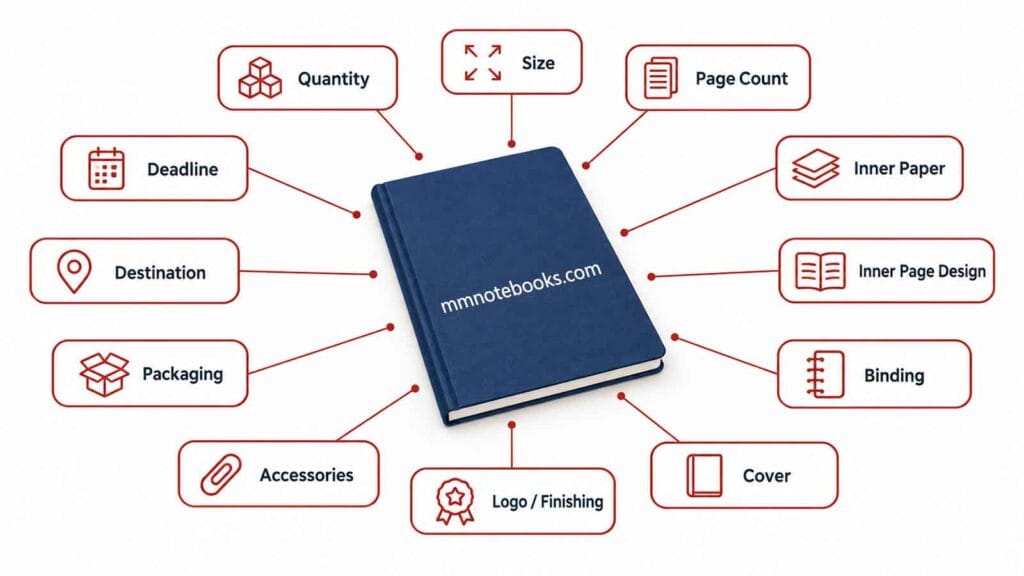
Ask a notebook factory for a price with a single line — “Please quote 1,000 custom notebooks with our logo” — and you will usually get an answer quickly. What you will not get is an accurate custom notebook quote, because that one sentence leaves out almost every detail that actually determines the cost.
To a manufacturer, “1,000 custom notebooks” is still missing the essentials: the finished size, the page count, whether the paper is 80gsm or 120gsm, whether the inner pages are blank, ruled or fully custom, whether the binding is spiral or sewn, whether the cover is soft or hard, and how the logo is applied — printed, foil-stamped or debossed. It also says nothing about elastic bands, ribbon bookmarks, pockets or individual packaging.
Without those details, each supplier quotes from its own default specification, and you are left with four prices that cannot be compared. This guide gives brands, corporate buyers, stationery distributors, schools and first-time notebook brands a ready-to-use RFQ checklist for a more accurate custom notebook quote.
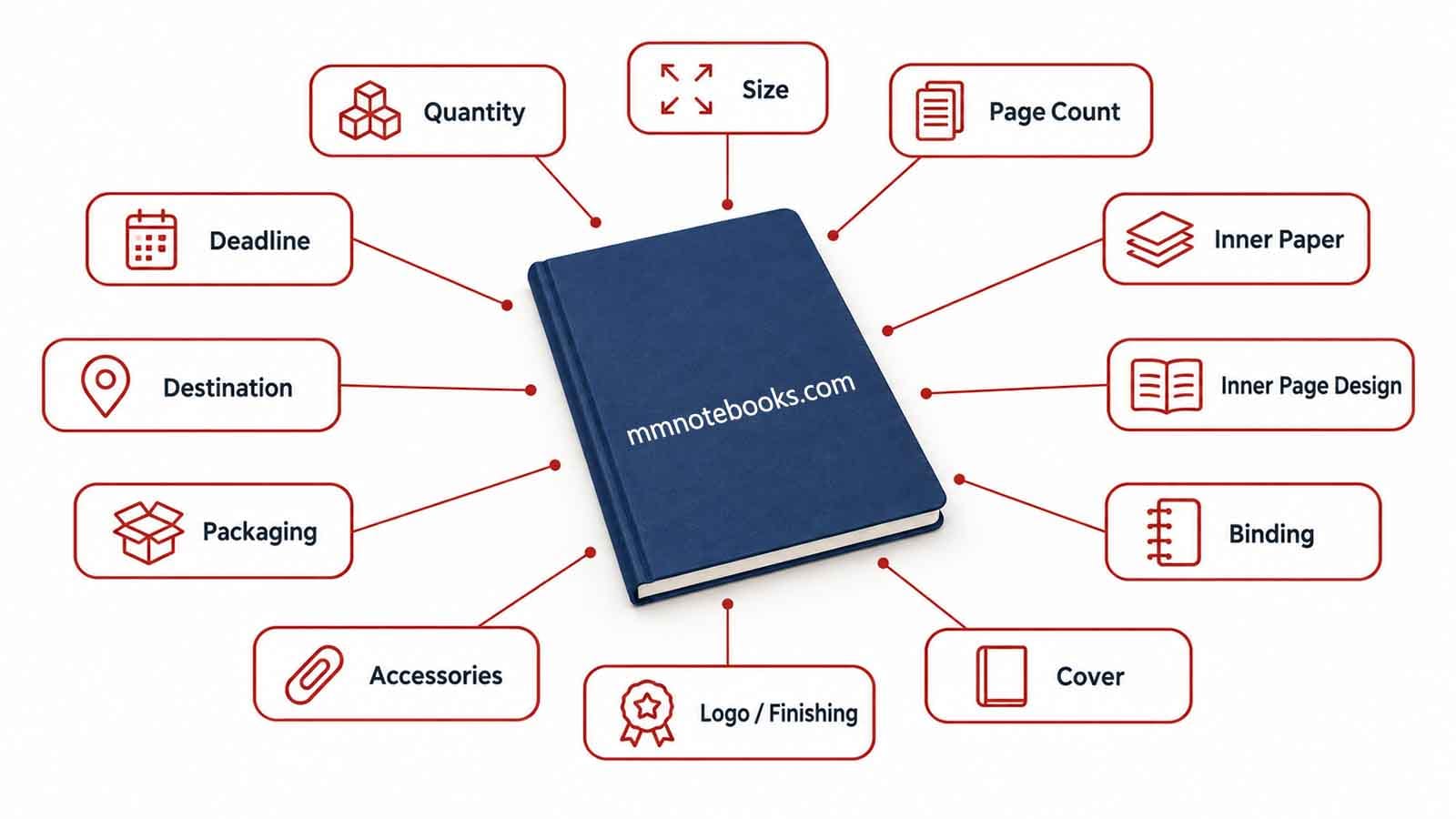
Custom Notebook Quote: Send These 12 Specifications First
If you only have a minute, put these twelve items in your first message to a notebook manufacturer. Each one moves the price, the MOQ, the sampling and the lead time.
| Quote information | Example |
|---|---|
| 1. Quantity per design | 500 / 1,000 / 3,000 pcs |
| 2. Finished size | A5, 148 × 210 mm |
| 3. Page count | 160 pages / 80 sheets |
| 4. Inner paper | 100gsm ivory uncoated writing paper |
| 5. Inner page design | Custom PDF, 2-colour printing |
| 6. Binding | Section sewn / Wire-O / perfect bound |
| 7. Cover structure | Hardcover, 2mm greyboard + PU |
| 8. Logo / finishing | Gold foil + blind deboss |
| 9. Accessories | Elastic band + 2 ribbon bookmarks |
| 10. Packaging | Individual OPP bag / belly band / gift box |
| 11. Destination | New York, USA |
| 12. Required delivery date | In warehouse before March 15 |
If you already have artwork, reference photos or a physical sample, send those too. If only half of the twelve are decided, write down what you know and clearly mark the rest as “factory recommendation needed”. That is more useful than guessing at a technical term you are not sure about.
1. Quantity: Give the Quantity per Design, Not Just a Total
A manufacturer first needs to know how many pieces each design or SKU will actually be produced in, not how many you might eventually buy in total.
- Total: 2,000 pcs
- Design A: 1,000 pcs
- Design B: 500 pcs
- Design C: 500 pcs
That is a different production project from 2,000 pieces of one design, because different covers, inner pages, colours and packaging each need their own production setup. If you have several colours, write them separately — “Navy: 600 pcs, Beige: 400 pcs” — rather than “1,000 pcs, two colours”. If you expect to reorder, mention it, so the supplier can recommend materials and structures that are easy to repeat. For more on how quantity interacts with production, see our guide to custom notebook MOQ.
2. Size: Name the Format and the Millimetres
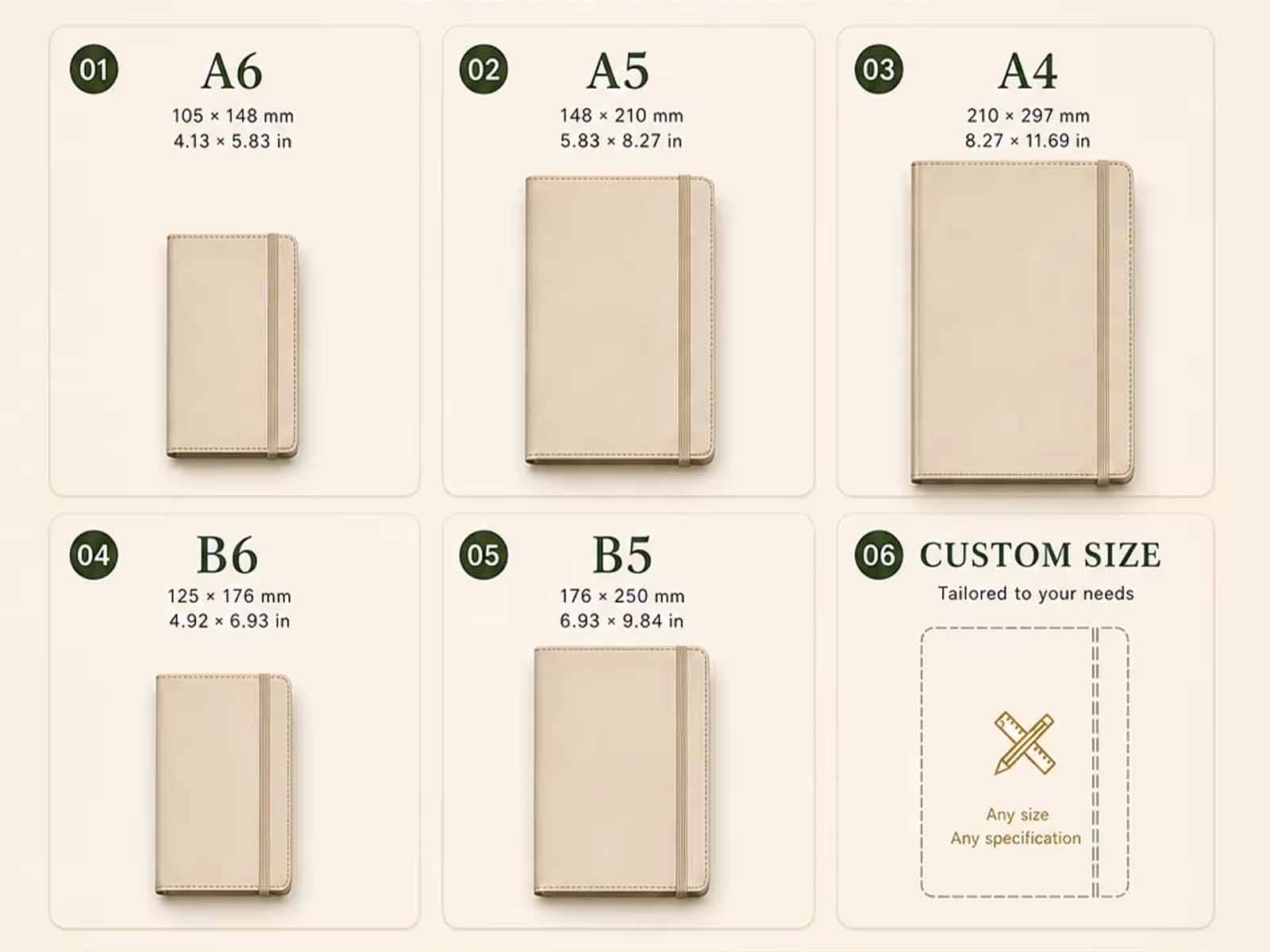
Do not write only “A5 notebook”. Write “A5, finished size 148 × 210 mm”. For special sizes, give millimetres or inches directly, for example 145 × 210 mm, 7 × 10 in, or 3.5 × 5.5 in. Also state the orientation — portrait, landscape, top-bound, left-bound — or whether the product opens right-to-left for an Arabic-language market. Paper sizes follow the ISO 216 system, so naming the standard and the exact dimensions removes ambiguity. If the product must fit an existing box or sleeve, do not give only an approximate “about A5”.
3. Page Count: Clarify Pages vs Sheets
One sheet equals two pages, so 80 sheets is 160 pages and 100 sheets is 200 pages. The safest way to write it in a quote request is “160 pages / 80 sheets”, not “80 pages” alone.
Also tell the factory whether every inner page is the same. Three products can all say “160 pages” and have completely different production logic:
- 160 pages, all ruled;
- a planner with monthly, weekly and notes layouts;
- a workbook where every page is different.
If there are many layouts, a simple list of the page structure is enough.
4. Inner Paper: Go Beyond “Good Quality Paper”
“High-quality paper” cannot be used for purchasing. State the GSM (70gsm, 80gsm, 100gsm, 120gsm), the shade (white, natural white, ivory or cream), and the intended use — ballpoint, gel pen, fountain pen, pencil or marker, or drawing and sketching. GSM is defined as paper grammage, but thicker does not automatically mean better to write on. If bleed-through, ghosting, smoothness or opacity matter, ask the factory for paper samples or test on a pre-production sample.
5. Inner Page Printing: Say When the Pages Are Fully Custom
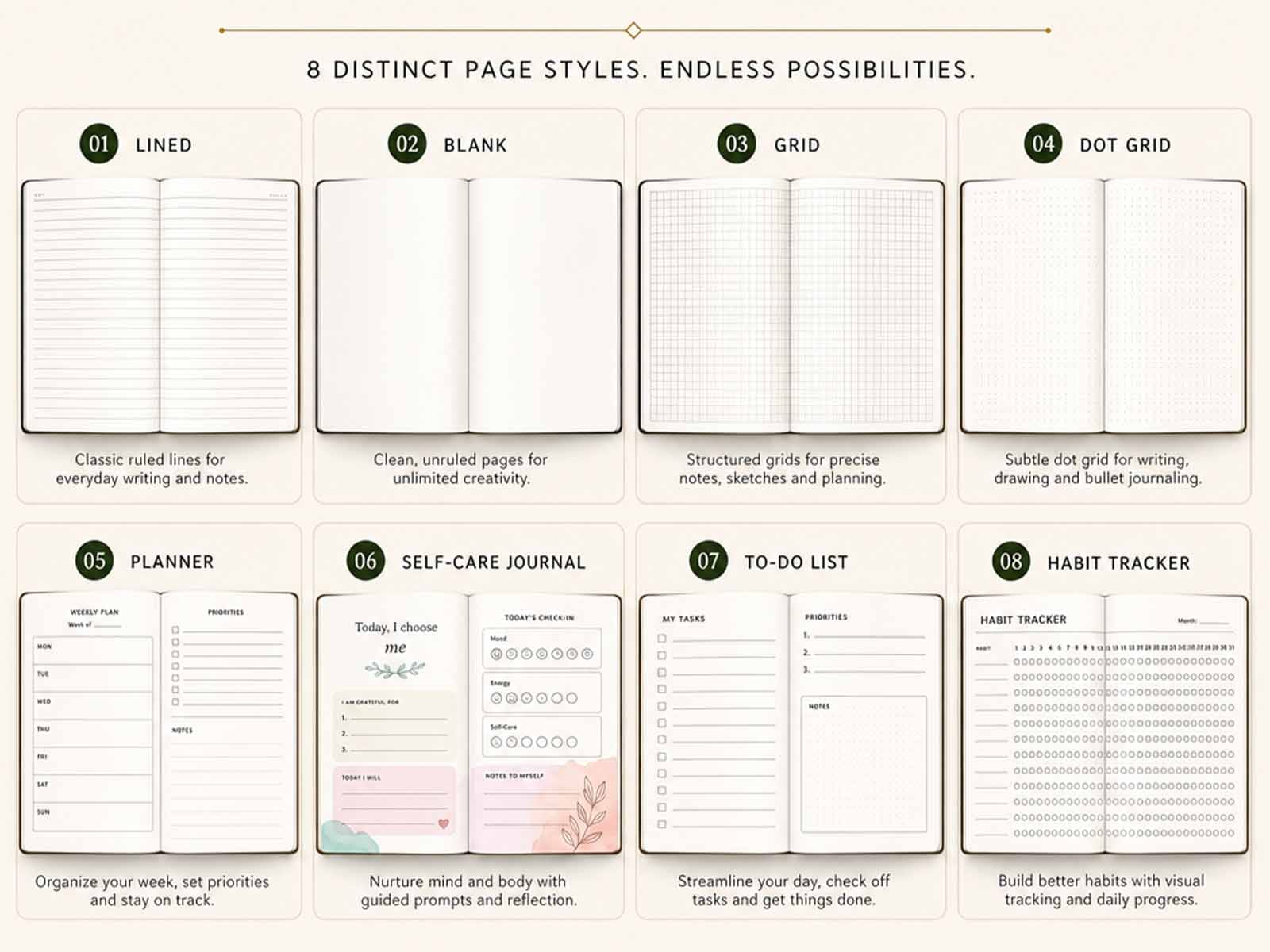
This is the most underestimated part of a custom notebook RFQ. Many suppliers call a notebook “custom” when only the cover logo is added, while the inner pages stay stock. If you actually need custom planner pages, questionnaires, checklists, a training workbook, journal prompts, school ruling or a fully custom PDF interior, write it directly: “Fully customised inner pages. We will provide print-ready PDF files.”
Also state whether the printing is black only, one spot colour, two colours or full CMYK. If only some pages are custom, say so — for example, “160 pages total, 140 pages standard dot grid, last 20 pages are custom forms.”
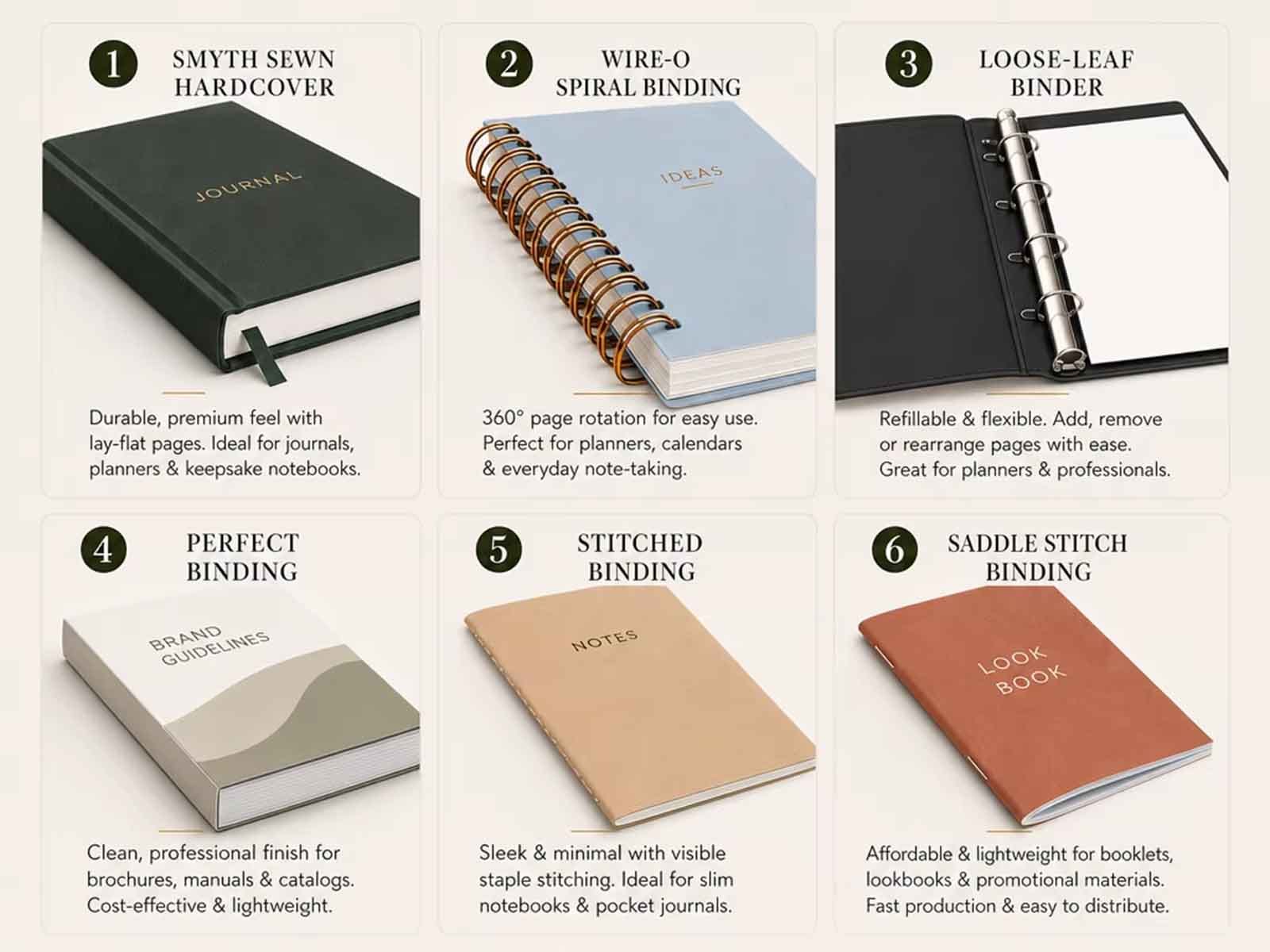
6. Binding: Describe How the Notebook Should Open
Common notebook bindings include spiral, Wire-O, perfect binding, sewn binding, section sewn or Smyth sewn, saddle stitch, ring binder and casebound hardcover. If you do not know the technical name, do not guess. Describe the function instead:
- “Must open flat on the desk.”
- “Pages need to rotate 360°.”
- “Needs a clean square spine.”
- “Pages must be removable and replaceable.”
- “We want a premium hardcover journal feel.”
Opening 360° and opening 180° flat are two different requirements. If you want a sewn structure, see sewn-bound notebooks for reference.
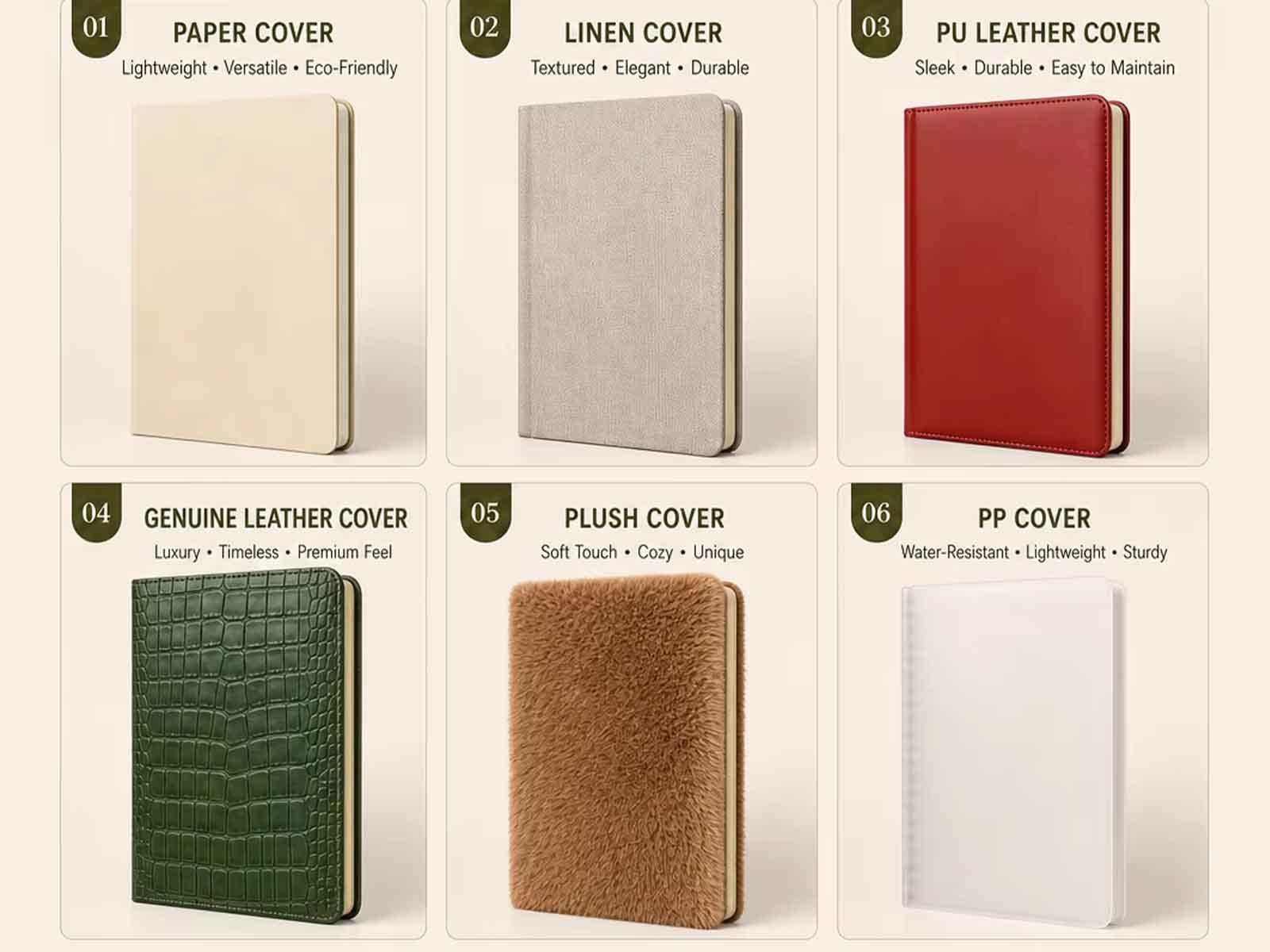
7. Cover: Specify More Than “Hardcover”
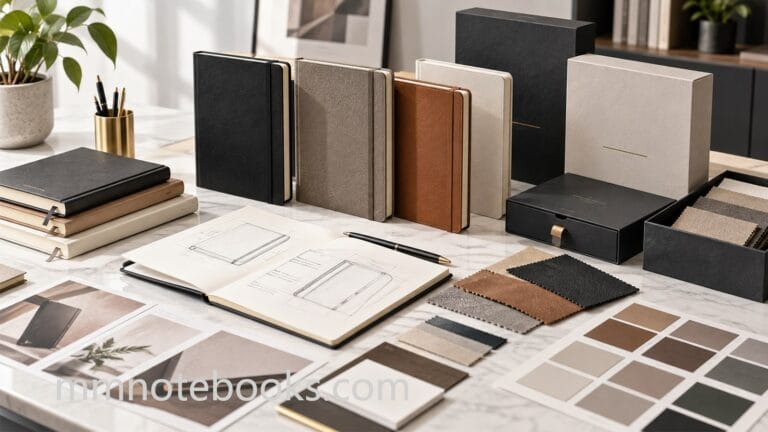
“Hardcover” is still not enough to quote. A manufacturer also needs the board thickness, the outer wrapping material, the printing, the lamination, the edge construction, the endpaper, the corners and the finishing. For example, “Hardcover, 2mm greyboard, wrapped with printed art paper, matte lamination” is a different product from “Hardcover, 2.5mm greyboard, wrapped with linen fabric”. If you do not know the material names, send reference photos and describe the feel and durability you want. See hardcover notebooks for construction options.
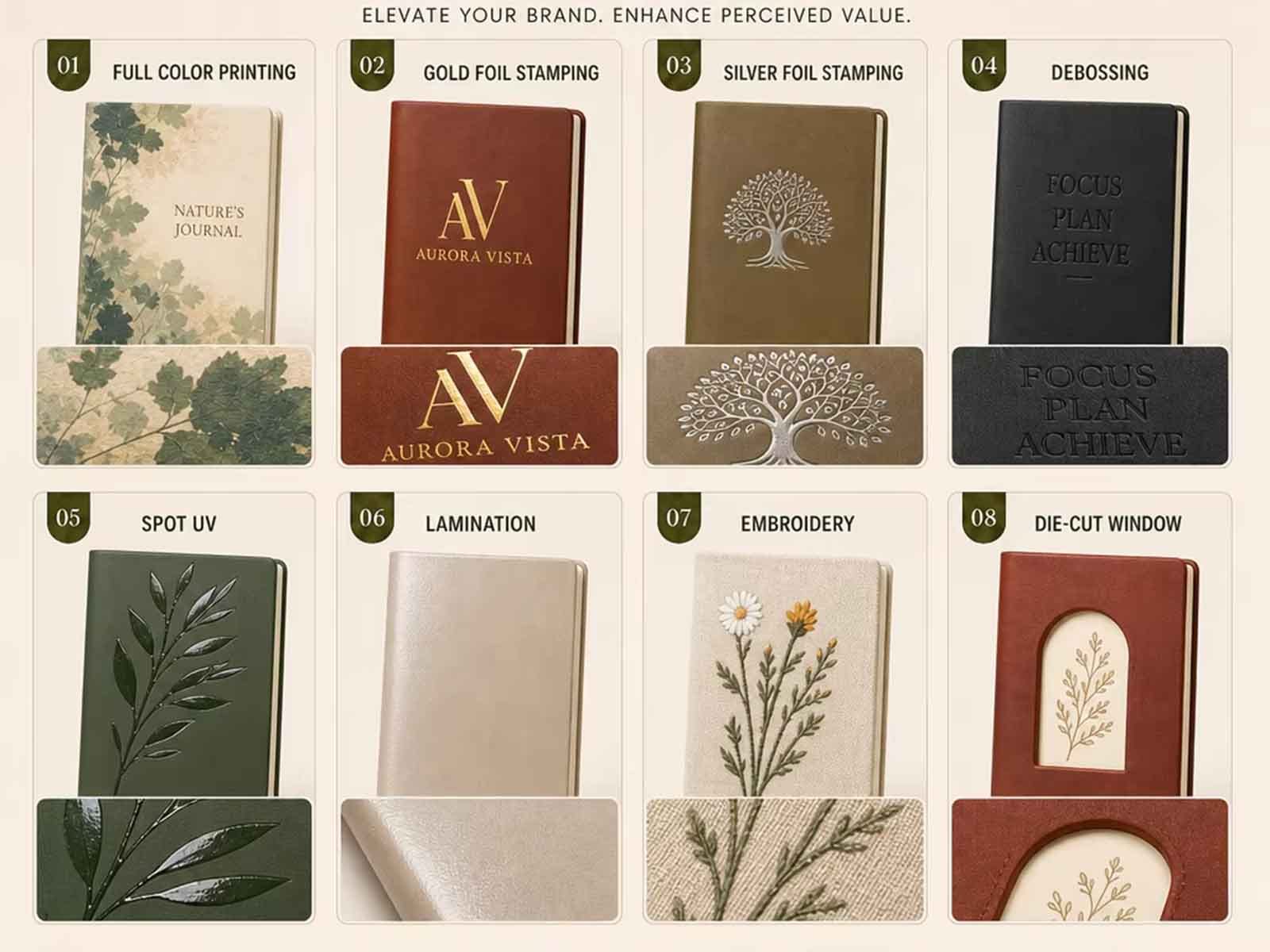
8. Logo, Printing and Finishing: Position, Size and Process
“Put our logo on the cover” is not enough. Confirm the position (front cover, back cover, spine, inside cover, belly band or packaging), the size (for example 40 × 25 mm), and the process — screen printing, full-colour printing, gold foil, silver foil, deboss, emboss, spot UV or laser engraving. If you have a brand colour, provide the Pantone reference. If the finishing is undecided, ask the factory for two options: a lower-cost solution and a premium solution.
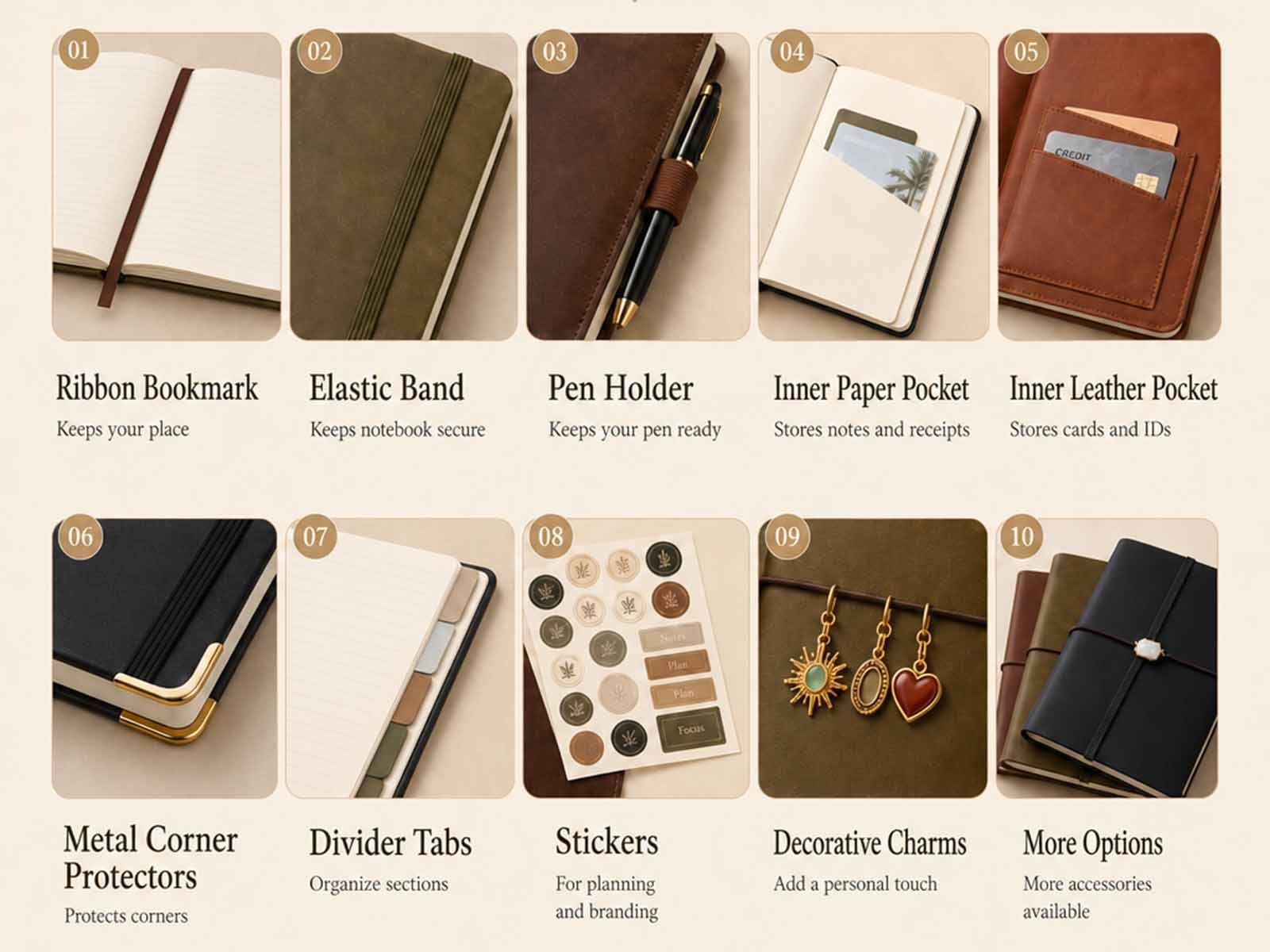
9. Accessories: Small Add-Ons Change the Price
Common accessories include elastic bands, ribbon bookmarks, pen loops, inner pockets, card slots, index tabs, dividers, sticker pages, magnetic closures, metal corners, an extra notepad and edge printing or gilding. Write out the quantity, colour and position of each. Accessories add both material and assembly labour, so they change the quote even when they look minor.
10. Packaging: Confirm It at the Quote Stage
Common packaging routes include bulk packing, individual OPP bags, POF shrink wrap, a paper belly band, a custom label, a holographic sticker, a mailer box, a top-and-bottom box, a rigid gift box and a retail box. Packaging changes carton size, weight, shipping volume, labelling and warehouse receiving. For a retail product, also mention barcodes, SKU labels, country-of-origin labels and carton marks.
11. Destination: Without It, You Get a Factory Price
Give at least a country and a city or port — Toronto, Canada; Los Angeles, USA; Hamburg, Germany; Dubai, UAE. If you have your own forwarder, you can ask for FOB; if not, ask the supplier to quote FOB, CIF or DDP options. This is the only way to avoid comparing prices on different trade terms.
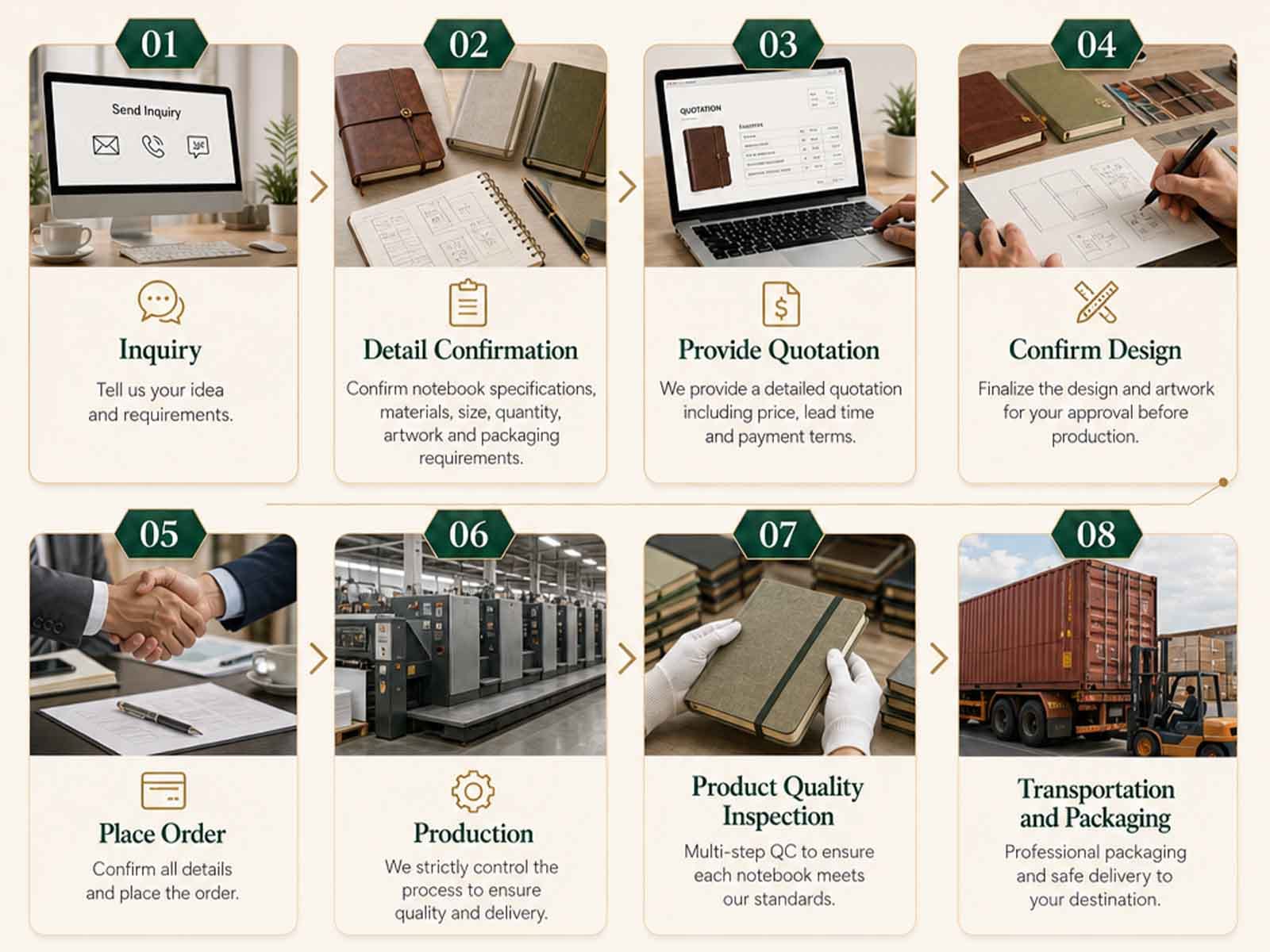
12. Required Delivery Date and Artwork Status
The useful question is not “how many days does production take?” but “can the notebooks be in my warehouse before my launch, event or school term?”. Write a required in-hands date, such as “Required in-hands date: March 15”, rather than “ASAP”. The factory then works backwards through artwork confirmation, sampling, material sourcing, bulk production, packing and shipping.
Also state where your artwork stands, in four simple stages: Stage A — idea only; Stage B — reference images; Stage C — design draft ready; Stage D — print-ready AI, EPS or press-ready PDF. You do not need to finish every file before the first quote; the first round is mainly to confirm the product structure and budget direction.
13. A Reference Sample Is Often the Fastest Shortcut
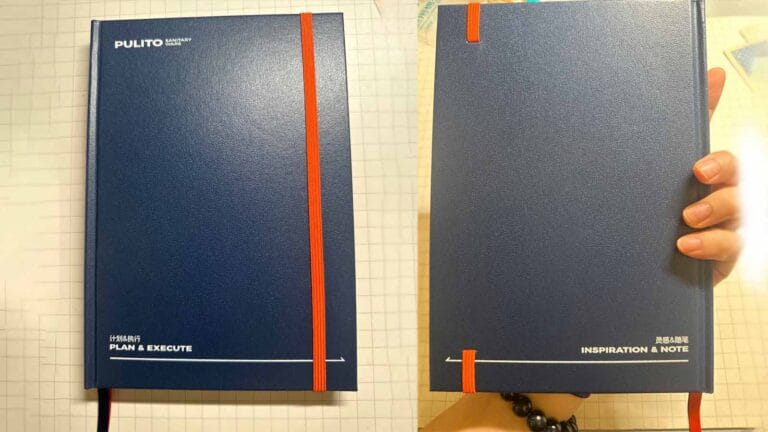
If you have a notebook that is close to what you want, tell the factory: “We want the same construction as this sample, but change the cover material, logo and inside layout.” A physical sample communicates board thickness, paper GSM and shade, binding, cover material, finishing, dimensions and accessories better than a written description. If you cannot send it, photograph the closed cover, the opened notebook, the spine, the inner pages, a material close-up and the packaging.
14. What You Do Not Need to Know on Your First Inquiry
An accurate RFQ does not mean the buyer must become a notebook engineer. On a first inquiry you do not need the exact paper-mill brand, the final board supplier, the precise glue type, the carton dimensions, the machine model or the final shipping carrier. You only need to make the product goal and the non-negotiable requirements clear. For example:
“We need a premium planner that lies flat, feels lighter than our current sample, uses fountain-pen-friendly paper, and should retail around USD 25.”
That kind of information is usually more useful than guessing at technical parameters.
15. A Hard-to-Quote RFQ vs a Ready-to-Quote RFQ
A hard-to-quote request looks like this:
“Hello, we need 1,000 custom notebooks with logo. Please send your best price.”
The problem is not that the email is short — it is that the product is undefined. A ready-to-quote request looks like this:
“Hello, we are developing a custom A5 planner for our brand. Please quote the following: Quantity 1,000 / 3,000 pcs; Size A5, 148 × 210 mm; Pages 192 pages / 96 sheets; Inner paper 100gsm ivory uncoated writing paper; Inner printing 2-colour custom pages, artwork supplied as PDF; Binding section sewn, 180° lay-flat required; Cover hardcover, PU-wrapped greyboard; Logo blind deboss on front cover; Accessories 2 ribbon bookmarks + elastic closure + rear pocket; Packaging individual OPP bag; Destination Toronto, Canada; Required delivery before March 15; Artwork status interior design 80% complete.”
Sent to several suppliers, a request like this produces quotes that can actually be compared.
16. How to Compare Two Custom Notebook Quotes
| Item | Supplier A | Supplier B |
|---|---|---|
| Quantity | 1,000 | 1,000 |
| Size | A5 | A5 |
| Pages | 192 | 192 |
| Paper | 100gsm ivory | 80gsm white |
| Inner printing | 2C | 1C |
| Binding | Section sewn | Perfect bound |
| Cover | PU hardcover | Printed paper hardcover |
| Logo | Deboss included | Extra |
| Accessories | Included | Ribbon only |
| Packaging | OPP included | Bulk packing |
| Sample | Extra | Extra |
| Trade term | FOB | EXW |
| Lead time | Confirmed | Estimate |
If the specification is not the same, the unit price cannot be compared directly. The greatest value of an accurate RFQ is not just getting a price — it is making different suppliers’ quotes comparable.
17. Should You Share Your Budget?
Yes, but do not say only “our budget is low”. It is more useful to write “Target landed cost: under USD X per notebook at 3,000 pcs”, or “We need to keep the notebook itself below USD X FOB — please suggest where the specification can be simplified.” That lets the factory adjust the parts that truly drive cost instead of blindly downgrading every material.
18. Ready-to-Send Custom Notebook Quote Template
Subject: RFQ – Custom Notebook / Planner

Company:
Destination country/city:

Product type:
Quantity per design:
Expected repeat order (optional):

Finished size:
Orientation / opening direction:

Page count:
Inner paper GSM:
Paper colour/shade:
Inner page layout:
Inner printing colours:

Binding:
Lay-flat / 360° requirement:

Cover type:
Cover material:
Board thickness (if known):

Logo position:
Logo size:
Logo/finishing process:
Pantone colour (if applicable):

Accessories:
Packaging:

Artwork status:
Reference photos/sample available: Yes / No

Sample required: Yes / No
Required delivery date:

Please quote:
1. Unit price at requested quantities
2. MOQ per design
3. Sample cost and sample lead time
4. Bulk production lead time
5. Packaging cost
6. FOB price
7. DDP / CIF option if available
8. Tooling / plate / die charges, if any
9. Recommended specification changes, if any
FAQ
Can a notebook manufacturer quote from a photo?
A photo supports a first judgement, but it usually cannot confirm paper GSM, board thickness, binding structure and some material details. For higher-value projects, send a physical reference sample.
Do I need finished artwork before asking for a quote?
No. As long as the size, page count, printing colours, binding, cover and quantity are roughly decided, you can get a budget quote first.
What if I do not know which paper to choose?
Tell the supplier the final use — everyday writing, fountain pen use, a student workbook, a premium journal or sketching — and let the factory provide paper samples or a sample notebook.
What if I do not know the binding type?
Do not guess. Tell the factory you need lay-flat, 360°, removable pages, a square spine or a premium hardcover appearance, and let it recommend the structure.
Should I ask for one quantity or several quantities?
If you are still evaluating budget, ask for two or three quantities, such as 500 / 1,000 / 3,000 pcs, to see the price breaks.
Can different designs share the same MOQ?
Usually no. Confirm by design or SKU, because different covers, inner pages or materials cannot automatically share one MOQ.
Get a More Accurate Custom Notebook Quote
A good notebook manufacturer should ask about every point where price, quality and production understanding could diverge — before quoting and before sampling. You do not need to know every technical parameter from day one. You only need to make four things clear: what product you are making, which specifications are already decided, which parts the factory can recommend, and when, how many and to where the goods must be delivered.
When those are clear, your first quote will be far closer to a real, orderable price — and when you request quotes from several suppliers at once, you will finally be comparing the same product rather than three different notebooks that three suppliers each imagined. If you are ready to define your specification, contact us and send your project details.