A school exercise book tender can list 100,000 pieces, a precise ruling, a specific paper GSM and a fixed delivery date — yet many first-time bulk buyers still start by asking ten factories to simply “give me your best price.” In large-volume tenders, the money is rarely lost on a unit price that is one cent too high. It is lost on a wrong specification, a miscounted page count, a missed vessel or a packing cost nobody included.
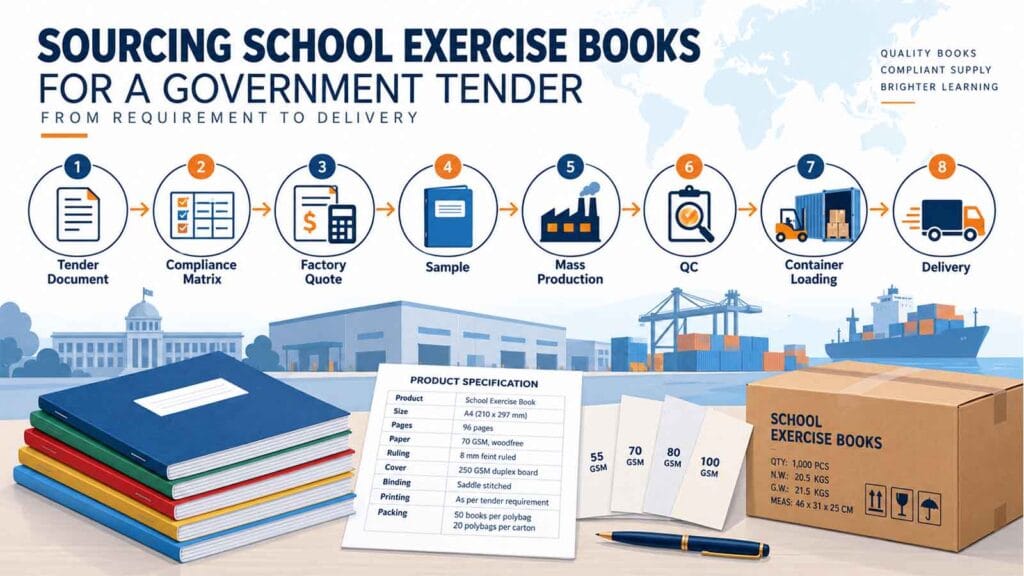
For a project of 10,000, 50,000, 100,000 or even a million school exercise books, the chain you need to lock down is: Tender Compliance → Manufacturing Specification → Cost Model → Sample Approval → Capacity → QC → Packing → Freight → Delivery.
This guide is written for school stationery distributors, tender contractors, education suppliers, importers, NGOs and government project suppliers who are sourcing school exercise books for a tender. The goal is not to tell you which factory is cheapest. It is to show you how to turn a tender document into a project you can actually deliver.
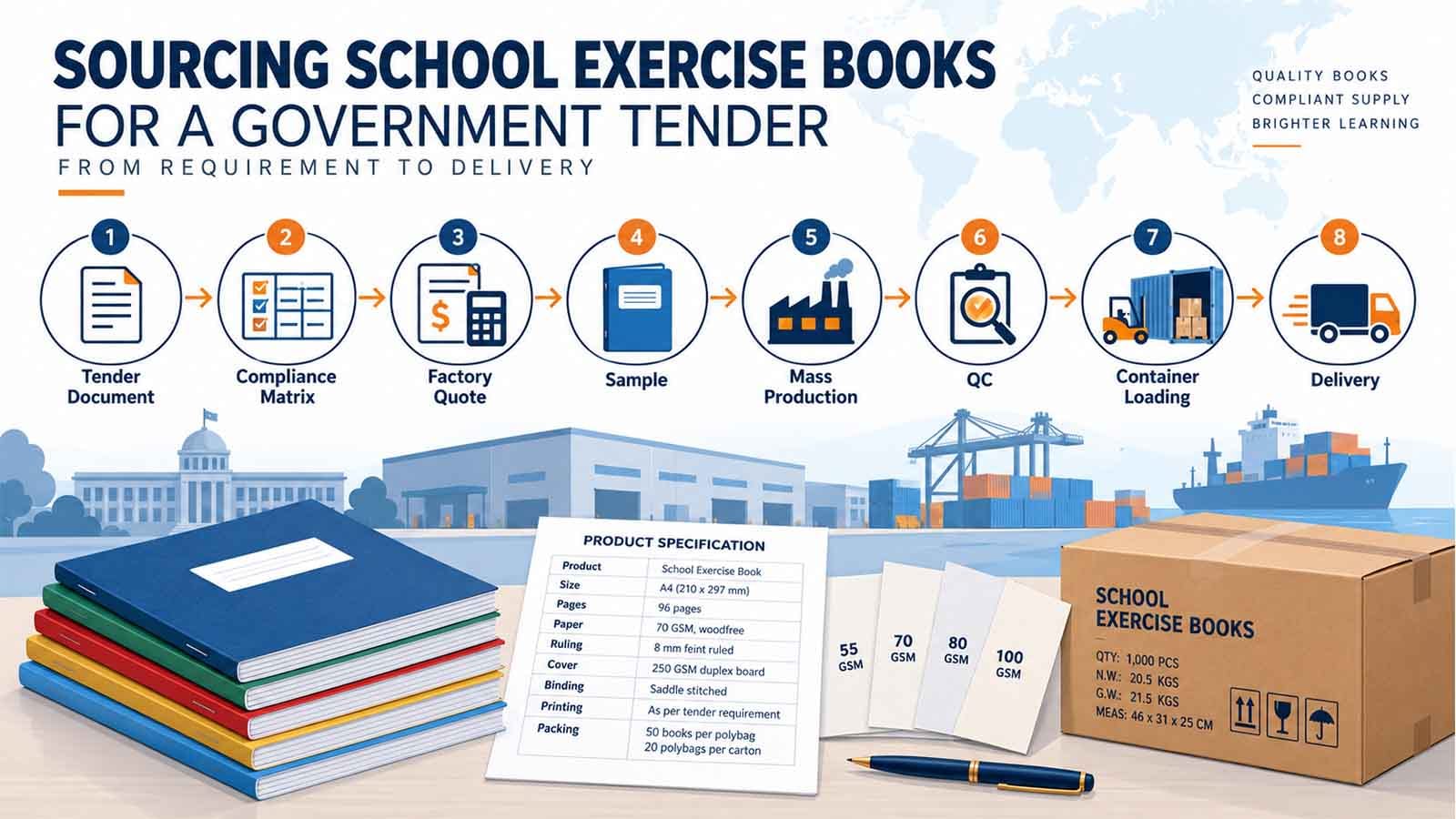
Why School Exercise Books for a Tender Are Different from a Normal Order
Recent public school exercise book tenders break the specification down into many fields: finished size, number of pages, ruling, inner paper type and GSM, cover type and GSM, subject, binding, packing, delivery location, required documents and delivery period. Some tenders even list different page counts, GSM values, ruled / unruled / grid rulings and several standard sizes as separate technical parameters.
This is why a Supplier A quote of USD 0.25 and a Supplier B quote of USD 0.31 cannot be compared directly. If A is quoting 56gsm paper and B is quoting 75gsm; if one is 64 pages and the other is 80 pages; if one uses a plain cover and the other a higher-GSM printed cover — they are not the same product at all.
For a tender, the most dangerous price is not “expensive”. It is a price that looks cheap but does not meet the specification.
Step 1: Turn the Tender Document into a Compliance Matrix
Do not forward the tender to a factory and ask for “your best price.” Build a compliance matrix first — it is the foundation of sourcing school exercise books for a tender. Split it into at least five categories:
| Category | Information to extract |
|---|---|
| Technical | Size, pages, GSM, ruling, binding, cover |
| Printing | Inner printing, cover printing, logo, subject |
| Packing | Inner pack, pcs/carton, carton marks, pallets |
| Commercial | Quantity, currency, Incoterm, payment |
| Tender | Deadline, samples, bid security, documents, delivery |
Then mark each line as Mandatory, Optional, Supplier to confirm, or Deviation allowed / not allowed. For example:
| Tender requirement | Required | Factory offer | Status |
|---|---|---|---|
| Inner paper | 75gsm | 75gsm | PASS |
| Size | 162 × 229 mm | 162 × 229 mm | PASS |
| Pages | 80 | 80 | PASS |
| Ruling | Both-side ruled | Both-side ruled | PASS |
| Cover | 280gsm | 250gsm | FAIL / Clarify |
| Delivery | 60 days | 55 days | PASS |
The value of this table is not that it looks professional. It is that you do not discover a missed mandatory specification only hours before the bid deadline.
Step 2: Translate Tender Language into Factory Language
A tender document is written for buyers and bidders. A factory specification is written for the production floor. A tender may say only “Exercise Book, 80 pages, single ruled, 75gsm.” A manufacturing specification should go further:
- Finished size
- 80 pages / 40 sheets
- Paper GSM tolerance
- Paper shade
- Ruling spacing
- Line colour
- Margin colour
- Printing side
- Cover GSM
- Cover artwork
- Staple position
- Trim tolerance
- Packing quantity
- Carton requirement
Pay Special Attention to Pages vs Sheets
Usually 80 pages = 40 sheets, but different tender documents may use pages, leaves or sheets. Do not guess. At 100,000 pieces, misunderstanding the count by 40 sheets per book is not a small error — it is a massive cost error.
Step 3: Six Technical Parameters Buyers Underestimate
1. Paper GSM
Exercise books are extremely sensitive to unit cost. The difference between 55gsm, 60gsm, 70gsm, 75gsm and 80gsm is very visible across hundreds of thousands of copies. Do not just ask “is the paper good?” — confirm the GSM, paper type, opacity, shade and writing performance against grammage (GSM).
2. Ruling
Single line, double line, four-line, square, graph and blank are not the same print job. Also confirm line spacing, margin, line colour and grid size.
3. Page Count
The material cost difference between 64 pages and 96 pages is direct and significant.
4. Cover GSM
The cover of a low-cost exercise book is not a trivial detail — some public tenders explicitly require a cover paper GSM.
5. Binding
Saddle stitch, sewn, perfect bound and spiral have completely different production methods and costs. See our guide to notebook binding types for the construction differences.
6. Packing
“72 pcs/carton” and “6 pcs/shrink pack × 12 packs/carton” give the same total, but the labour and packaging cost are not the same.
Step 4: Sourcing School Exercise Books for a Tender Is Not Just Unit Price × Quantity
Take a real specification as an example. A B5 marble / snowflake exercise notebook might be:
- Finished size: about 19 × 24.7 cm
- Inner sheets: 100 sheets
- Inner paper: 53gsm offset paper
- Packing: 6 pcs / heat-shrink pack
- 72 pcs / export carton
- Carton size: 39.8 × 26.5 × 32.5 cm
- Gross weight: about 20.5 kg / carton
- Carton volume: about 0.03428 CBM
What 10,000 pieces really means
At 72 pcs/carton, 10,000 pieces needs about 139 cartons (the last carton may be short). Using full-carton data for logistics:
| Metric | 10,000 pcs | 100,000 pcs |
|---|---|---|
| Cartons | ≈ 139 | ≈ 1,389 |
| Volume | ≈ 4.76 CBM | ≈ 47.6 CBM |
| Gross weight | ≈ 2.85 tons | ≈ 28.5 tons |
At this point a freight forwarder no longer needs “I have 10,000 notebooks.” It needs 139 cartons / approximately 4.8 CBM / approximately 2.9 tons.
This also reveals an important rule for large tenders: container planning cannot look at CBM alone. Volume may still have room while weight has already become the limit. Before booking, ask the forwarder for a formal loading plan based on carton count, gross weight, CBM, port, container type and local road weight limits.
Step 5: Why Container-Scale Volume Matters for Low-Cost Exercise Books
This is especially true for staple / saddle-stitched school books. They are structurally standard, low in unit value, paper-heavy and fast to produce — and very sensitive to machine utilisation. A few hundred pieces can barely spread the cost of machine setup, plates, paper waste, labour and packing. At 10,000, 50,000 or 100,000 pieces, the unit economics improve clearly.
But “a full container is always cheapest” is not a universal rule. The figure you should compare is Total Landed Cost / Usable Book, not the factory unit price alone.
Step 6: Ask for Multiple Quantity Tiers
If a tender says “Estimated Quantity: 100,000 pcs,” ask the factory to quote at least 10,000, 50,000, 100,000 and 125,000 pcs (in case the tender allows a quantity variation). Recent public exercise-book tenders have shown ±25% quantity variation. If you cost the material and margin only at 100,000 and the buyer later raises it to 125,000, you may win the tender without the paper, production slot, cash flow, cartons or freight capacity ready. Sourcing school exercise books for a tender needs not just the lowest price — it needs scalability.
Step 7: Ask About Capacity, Not Just “Are You a Factory?”
For a 100,000+ piece tender, the more useful question is: can you finish this specification within my delivery window? Ask:
- Monthly capacity for this binding?
- How many production lines can run this item?
- Which processes are in-house, and which are outsourced?
- How much paper can be reserved after the PO?
- Can you handle a 25% quantity increase?
- What is the bottleneck process?
- How many days for 100,000 pcs?
- Can production be split into lots?
A supplier saying “we can produce millions of notebooks” tells you little. What you need is: how much of this exact specification, in this period, can you give my project?
Step 8: Factory Visits Are Worth It — Bring the Right Questions
For 10,000+ and especially 100,000+ tender projects, an in-person meeting is genuinely valuable — a factory visit, Canton Fair, the Yiwu International Trade Market, stationery fairs or sourcing-office meetings. The main value is not “seeing many samples,” but directly confirming paper warehouse, printing, folding, stitching / sewing, binding, packing, finished-goods storage, QC and loading capability.
Whatever route you take, do not assume a large factory automatically fits your tender. Tender fit always comes down to specification + price + capacity + documents + delivery.
Step 9: Make the Golden Sample Part of the Contract
The most dangerous phrase in a large order is “same as sample” — because both sides may not remember the same thing. Before mass production, lock an Approved / Golden Sample and record its Sample ID, approval date, paper GSM, paper shade, ruling, line spacing, cover, binding, print colours and packing. The buyer keeps one and the factory keeps one.
For projects above 10,000 pieces, the sample fee is not a waste. It buys a shared standard before production starts.
Step 10: Do Not Leave QC Until the End
Quality control for a large tender should be staged:
- Incoming material: check paper, cover material, ink and packaging.
- First-off production: check trim size, ruling, colours, page sequence and binding right after the first machine run.
- During production: sample GSM, page count, print registration, missing pages, binding, cover and defects.
- Pre-shipment: confirm finished quantity, carton quantity, gross / net weight, carton marks, packing, appearance and contract specification.
The real danger is not finding 10 defective books. It is finding a systematic error at book number 90,000.

Step 11: Price the Landed Cost, Not the Factory Price
A real large-order cost model includes at least:
- Product: paper, cover, printing, binding, packaging, production waste.
- One-time / setup: plate, proof, sample, tooling, testing (where applicable).
- China-side logistics: factory to port, export handling, documentation, terminal-related costs (per Incoterms).
- International freight: sea freight, insurance, surcharges.
- Destination: customs, duty / tax, port charges, inland delivery, unloading / warehouse.
- Tender risk: currency fluctuation, paper price fluctuation, quantity variation, bank charges, inspection, performance security, late-delivery risk.
The question to answer is not “what is the China factory price?” but “what is the delivered cost per compliant school exercise book for a tender?”
Step 12: Do Not Ignore Non-Product Costs in the Tender
A tender may also include bid security / EMD, a performance guarantee, experience and turnover requirements, OEM authorisation, technical certificates, sample submission, bid validity, liquidated damages, a delivery bond or payment after delivery. Recent 100,000+ exercise-book tenders have included EMD, bidder experience, past performance, OEM documentation and a long bid-validity period.
In other words: having the product does not automatically make you eligible to bid. When a buyer is looking for a China factory, send the tender’s supplier-document requirements along with the specification.
Step 13: The Lowest Price Is Not Always the Winning Price
Some public exercise-book RFQs use Lowest Evaluated Responsive Tenderer. Three words matter here:
- Lowest: the price is competitive.
- Evaluated: the quote has passed technical and commercial evaluation.
- Responsive: the bid must substantively respond to the tender requirements.
The real ranking is closer to Compliant first → Commercially acceptable → then price, not “price first, then fix the specification later.” Do not bid a price you cannot execute just to win. Winning and then losing money — or failing to deliver — is not a victory.
Step 14: Back-Calculate the Delivery Date
If a tender requires delivery to the destination warehouse by August 1, work backwards:
August 1 — Warehouse Delivery
← Customs / Inland Transport
← Sea Freight
← Port / Documentation
← Pre-Shipment Inspection
← Packing
← Mass Production
← Bulk Material Preparation
← Sample Approval
← Artwork Confirmation
← PO / Deposit
Then add a risk buffer. A school term does not automatically move because the vessel was seven days late.
Step 15: Do Not Lock the Shipping Method Too Early
Sea freight is the obvious choice for large exercise-book orders, but a tight deadline does not always mean everything must travel the same way. You could ship the first 5,000 pcs by air and the remaining 95,000 by sea. Whether that is worth it depends on comparing late-delivery cost vs expedited freight cost. Sometimes getting a small batch in first — to hit a tender milestone — is far more reasonable than air-freighting the whole order.
Step 16: Give the Forwarder Cartons + CBM + Gross Weight
Do not send a forwarder “100,000 notebooks to Tanzania, please quote shipping.” What it actually needs is: cartons, carton dimensions, total CBM, gross weight, pickup location, destination port, commodity and ready date. Exercise books are a classic “volume is not dramatic, but weight grows fast” cargo.
Step 17: Request a Full Quote Breakdown
Ask each factory to return the same breakdown so you can compare three quotes side by side:
| Quote item | Supplier response |
|---|---|
| Unit price | |
| Quantity basis | |
| Paper GSM | |
| Pages / sheets | |
| Cover spec | |
| Binding | |
| Packing | |
| Pcs / carton | |
| Carton size | |
| Gross weight | |
| CBM | |
| Sample cost | |
| Sample lead time | |
| Production time | |
| Monthly capacity | |
| FOB port | |
| Price validity | |
| Quantity variation capacity |
Step 18: RFQ Template for a School Exercise Book Factory
Subject: RFQ – School Exercise Books for Tender

Tender / Project:
Destination Country:
Destination Port / City:

Product:
Finished Size:
Number of Pages:
Number of Sheets:
Inner Paper Type:
Inner Paper GSM:
Paper Shade:

Ruling:
Line / Grid Spacing:
Line Colour:
Margin:

Binding:
Cover Material:
Cover GSM:
Cover Printing:
School / Project Logo:

Quantity — please also quote:
- 10,000 pcs
- 50,000 pcs
- 100,000 pcs
- 125,000 pcs (optional)

Packing:
Inner Pack:
Pcs / Export Carton:
Carton Mark Requirement:

Required Documents:
Sample Required:
Inspection Requirement:

Required Delivery Date:
Preferred Incoterm: FOB / CIF / DDP

Please provide:
1. Unit price
2. MOQ
3. Sample cost
4. Sample lead time
5. Production lead time
6. Monthly capacity for this exact item
7. Pcs/carton
8. Carton dimensions
9. Gross weight/carton
10. Total CBM
11. Price validity
12. Payment terms
13. Ability to increase quantity by 25%
14. Available tender / export documents
A Final Red-Line Checklist Before You Submit
- Is the size correct?
- Have pages / sheets been confused?
- Is the paper GSM fully met?
- Is the ruling spacing confirmed?
- Is the cover GSM / structure compliant?
- Is the binding consistent?
- Is packing included in the price?
- Have carton count / CBM / weight been calculated?
- Is the sample approved?
- Does supplier capacity cover the tender quantity?
- Is quantity variation reserved?
- Is the freight quote still valid?
- Is there a buffer for currency fluctuation?
- Are the tender documents complete?
- Is the delivery deadline actually achievable?
If three of these still say “should be fine,” you are not ready to submit the final bid price.
Planning a China Sourcing Trip?
If your project goes beyond school exercise books — several categories, factory visits, the Yiwu market or freight planning — keep product sourcing and the sourcing trip separate. These projects usually involve a supplier shortlist, factory visits, sample collection, quote comparison, a freight forwarder, a China itinerary and Yiwu / Canton Fair sourcing. The China-sourcing-execution side is gradually being gathered at purchaseinchina.com, while notebook specifications, samples, production and quotes stay on mmnotebooks.com. That keeps the roles clear: mmnotebooks.com = Notebook sourcing & manufacturing, and purchaseinchina.com = China sourcing trip & supplier discovery.
FAQ
Is 10,000 exercise books considered a large order?
For standard exercise books, 10,000 pcs is already solid bulk-procurement territory, but many government, school-system and large distributor projects reach 50,000, 100,000 or more.
How much do 10,000 school exercise books cost?
There is no single price. Size, pages, paper GSM, ruling, cover, binding, printing, packing and Incoterm all change the cost.
What is the cheapest binding for bulk school exercise books?
Large standard exercise books often use saddle stitch / staple because it suits high-speed, standardised production, but “cheapest” still depends on page count, size, quantity and machine setup.
Should I buy directly from a factory for a government tender?
Working directly with a manufacturer usually helps with technical confirmation, cost and production communication, but a trading or sourcing company can also provide consolidation and export services. A tender buyer should choose on specification, capacity, documents, delivery and total cost.
Do I need a physical sample before bidding?
If the tender specification is complex or requires sample submission, a physical sample is very important. Even when it is not required, an approved / golden sample is recommended before 100,000+ piece production.
How do I calculate sea freight for 10,000 notebooks?
At minimum, first obtain total cartons, carton dimensions, total CBM, gross weight, origin, destination and cargo-ready date.
Is one container always cheaper?
Not necessarily. Whether a container load makes sense depends on volume, weight, destination-port charges, LCL / FCL pricing, order timing and local transport limits.
Can tender quantity change after award?
It depends on the tender terms. Some public procurement contracts include a quantity variation or option clause.
What documents should I ask a notebook factory for?
Depending on the tender, this can include company registration, export documents, product specification, test / compliance documents, samples, OEM authorisation, prior supply information, and post-shipment commercial invoice and packing list.
Conclusion: The Cheapest Mistake Is Often the Most Expensive
School exercise books have a low unit price, so buyers easily fixate on “can we save another 0.5 cent?” But across 100,000 pieces, one wrong page count, one wrong ruling, one wrong carton configuration or one missed vessel can erase all of those savings.
Mature tender sourcing is not about squeezing a supplier to the lowest price. It is about locking specification, price, capacity, quality, packing, freight and deadline into one executable plan — and only then knowing whether your bid price is one you can actually stand behind.
If you are preparing to source school exercise books for a tender and need a compliant quote, contact us with your specification to get started.