Most new brands start their first private label notebook inquiry the same way — not with a complete supply-chain plan, but with one simple question: “Can you make 500 pieces?”
The answer is usually yes. But the question that actually matters is not whether a factory will accept 500 pieces. It is whether your product design is the right fit for only 500 pieces.
If you want a branded variation of a mature structure — an A5 hardcover, a PU cover, a custom logo, custom inner pages, an elastic band, a ribbon bookmark and simple packaging — then 500 to 1,000 units is already a realistic test quantity. But if you have only 200 pieces and still ask for a special blue fibre paper, an exclusive re-made paper, fully custom hardware, a die-cut cover, several molds and a complex gift box, the real constraint is usually not the notebook factory but the upstream material supplier. Special papers, fabrics, hardware and packaging each carry their own minimum order quantity.
So the point of a 500–1,000 unit project is not to cram every idea into one product. It is to launch a private label notebook that customers remember by getting the one or two right details exactly right.
First, the Point: 500–1,000 Units Validates a Brand, Not Your Design Skills
Many first-time notebook founders fall into one trap: “If I am making my own brand, it must be a notebook that has never existed before.” That is not necessarily true. Customers do not buy automatically just because you added thirteen special finishes.
Real brand difference can come from a single striking cover artwork, a clearly defined audience, an inner layout that understands its user, a memorable brand story, a local cultural element, a clever size-and-binding combination, or one consistent packaging and visual language.
For a first launch of 500–1,000 units, I recommend mature structure + clear positioning + one or two strong points of difference — rather than a brand-new structure, special materials, new molds, many accessories, high development cost and low quantity. The latter burns your budget on production complexity before you have sold anything.
What 500 Units and 1,000 Units Are Each Good For
| First-run quantity | Best for | Suggested SKUs | Product strategy |
|---|---|---|---|
| 500 pcs | Validating one product | 1 hero SKU | Test the market with your strongest design |
| 1,000 pcs | Some channel / content traffic | 1–2 SKUs | Test a colour or cover difference |
| 2,000+ pcs | A clear sales plan | 2–4 SKUs | Start building a series |
| 5,000+ pcs | Distribution / steady e-commerce | Multiple SKUs | Optimise unit cost |
The most important rule here: do not split 500 units into ten designs of fifty each. In real OEM / private label production, the MOQ is usually counted per design or SKU, not across the whole order. If your first budget only covers 500–1,000 units, focus on one hero product that truly represents the brand instead of many shallow SKUs.
Step 1: Decide Why Someone Would Buy Your Notebook
Before choosing paper, answer one question: why would a customer not just buy an ordinary notebook? That answer is your product core.
Productivity brand
The hook might be a 90-day system, ABCDE priorities, habit tracking, weekly review or focus planning.
Travel / city brand
The hook might be city illustrations, route pages, a travel log, local landmarks or a pocket size.
Premium lifestyle brand
The hook might be the cover material, tactile feel, elegant branding, premium paper and packaging.
Student brand
The hook might be subject-specific pages, a study planner, an exam tracker, a timetable and an affordable price.
Creator / fan-community brand
The hook might come from creator identity, inside jokes, fan symbols, limited edition and storytelling.
If you already have an audience, a community, social accounts, a shop or a retail channel, customers buy your product for more than the notebook itself — so you can spend more on creativity and brand recognition. If you are starting from zero, your first product needs value for money + a clear use case + a good-looking cover + an acceptable retail price instead.
Step 2: The Smartest Innovation Is Usually Not Reinventing the Notebook
You can, of course, design something wild — a bronze-door cover, a radio or record shape, special translucent pages, special fibre paper, a vintage metal structure, a hidden mechanism, or a multi-layer die-cut build. These products are not impossible, and some even suit creator collaborations, limited editions, crowdfunding, fan merchandise, premium gifts or art projects.
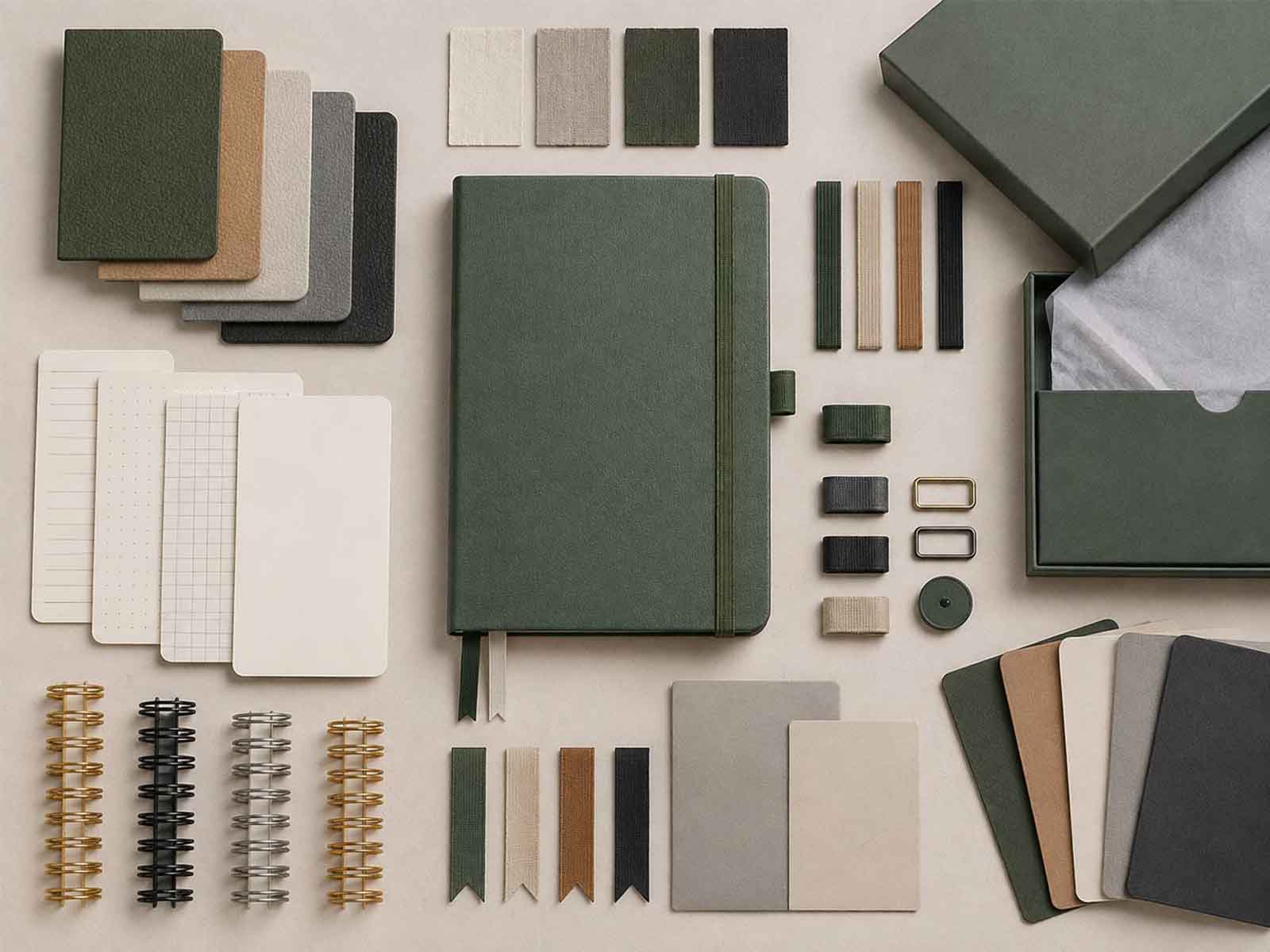
But they usually behave like a product-development project, not a low-MOQ private label project. For a new brand with a 500–1,000 unit first order, the smarter move is to start from a mature notebook structure and put the innovation where customers can see it: the cover, artwork, inner pages, colour system, packaging and brand story. These are the positions that are easiest to see and cheapest to control.
Step 3: Why a “Special Paper” Suddenly Makes 200 Pieces Hard
Many buyers ask: “I am only changing the paper — why does the MOQ suddenly jump?” Because a notebook factory does not produce every paper itself; it buys from an upstream paper supplier. Ordinary white or ivory writing paper has mature market stock, but a special blue fibre paper, custom-dyed paper, exclusive texture, special recycled pulp, a non-standard GSM or a special coated surface can push the upstream supplier to require a whole roll, a full lot, a minimum weight or a minimum production batch.
In other words: you want only 200 pieces, but the factory may have to buy enough material for several thousand. That is why the notebook MOQ can be low while the material MOQ cannot. It is also why a 500–1,000 unit brand project is better off using stock paper, stock cover material, standard elastic colours, standard ribbons and an existing binding structure — and spending the real money where customers can see it. The finished-product MOQ is only the tip of the iceberg:
| What you order | What actually sets the MOQ behind it |
|---|---|
| 500 notebooks | Paper MOQ |
| Cover material MOQ | |
| Printing setup | |
| Foil die | |
| Packaging MOQ | |
| Hardware MOQ |
Step 4: The Cover Is Usually Worth More Than a Complex Structure
If you are building a brand from zero, I would put a lot of weight on the cover, for one simple reason: the cover is what a customer sees in one second. A good cover solves shelf impact, social-media thumbnails, product photography, gifting appeal and brand recognition at once — and “good” does not mean expensive. You can create strong difference on a mature structure through local culture (local architecture, scenery, city maps, dialect, landmarks, folk patterns), a specific audience (nurses, teachers, architects, students, readers, travellers, entrepreneurs), or a consistent brand visual (one colour palette, typography, illustration style and logo placement). For a first 500 units, getting the cover right builds recognition faster than developing three die-cut structures at once.
Step 5: Innovate the Inner Pages Without Making a Brick Nobody Carries
A typical creative idea goes like this: someone wants one notebook that runs continuously from 2027 to 2030 — very thick and very impressive. It sounds differentiated, but stuffing three or four years of content into one book can push it past 1,000 pages, until it is no longer a notebook you want to carry, flip and use long term. Creativity is not the same as usability.
When a new brand innovates inner pages, ask three questions: will the user really use it every day? Will it feel too heavy, too thick or hard to flip after six months? Can this function be split into a series instead of one book? For example, instead of one 4-year planner, a Year 1 / Year 2 / Year 3 / Year 4 series — or a 12-month core planner plus a refill / companion notebook — can create repeat purchase, collection, yearly refresh and gifting opportunities.
Step 6: Do Not Pick the Wrong Binding for a 500–1,000 Unit First Order
Different bindings change the MOQ, cost, lay-flat behaviour, page count, durability, packaging and shipping weight. In the structure range MM Notebooks currently offers, the typical starting quantities are roughly: hardcover / PU leather / planner from about 500 pcs per design; sewn / perfect bound / spiral / wire-o from about 1,000 pcs per design; exercise books higher; and saddle stitch better suited to high-volume production.
So if your first order is 500 pcs and you insist on a structure better suited to 1,000 pcs, do not jump straight to “can you reduce the MOQ?” A more effective question is: “Can we achieve the same user experience with a structure that works at 500 pcs?” That is product development, not simply cutting the MOQ.
Step 7: What Usually Blows the Budget Is “Adding a Little of Everything”
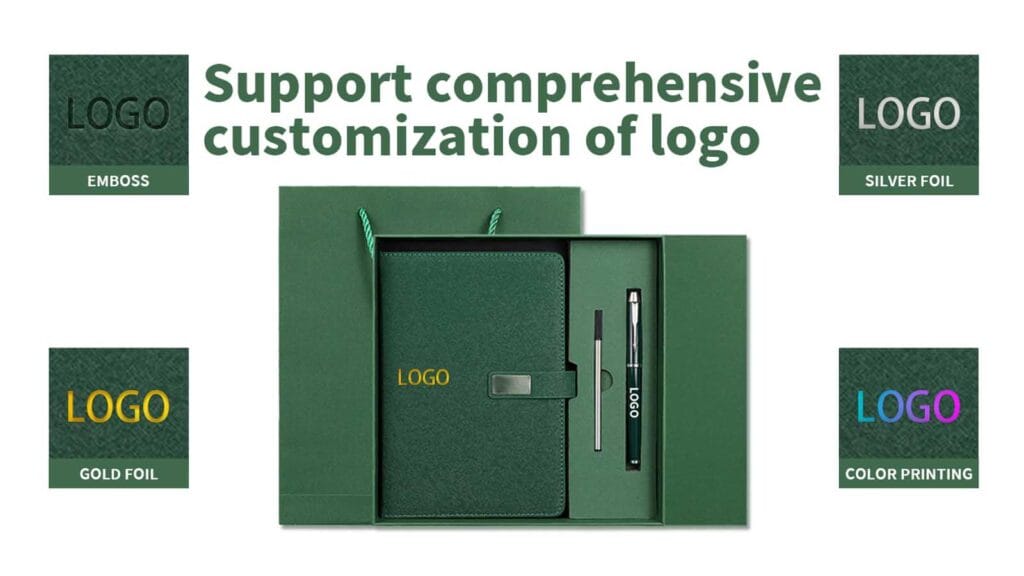
Say the base A5 private label notebook is confirmed. Then you start adding two ribbons, an elastic band, a pen loop, a back pocket, a magnetic closure, gold foil, deboss, edge printing, a custom sticker, a rigid gift box, a belly band and a custom mailer. Each item looks “not expensive” on its own — but together they raise product cost, labour, packaging volume, sample time, QC items and shipping cost at once.
For a first run, choose one hero finish — a blind deboss, a gold foil, a spot UV or a full-cover illustration — and let that become the main visual memory point, instead of stacking every finish together.
Step 8: Set the Retail Price First, Then Work Back to the Factory Cost
Many new brands start by asking “how much is the factory price?” A more useful order is: what is the customer willing to pay? How much does the sales channel take? What do packaging and fulfilment cost? Then work backwards to a target landed product cost. Different channels — marketplace, retailer, distributor or paid ads — have completely different margins.
Tell the factory a target like “target landed cost: under USD X” rather than “please give me your cheapest price.” With a price target, the factory can adjust paper, page count, binding, finishing and packaging instead of simply switching to the worst materials.
Step 9: If You Already Have an Audience, Your Strategy Can Be Different
A creator with a precise fan base and a new brand with a fresh Shopify store can both order 500 units and still need completely different products.
With an audience
You can be bolder: a collector edition, an unusual cover, a custom inner concept, a higher sample cost, a niche theme, a limited quantity — because you already have a good idea of who will buy it.
Starting from zero
Control SKUs, unit cost, packaging and product complexity. The goal of the first run is not to prove how bold you are — it is to verify whether a group of strangers will pay.
Step 10: Do Not Make Five SKUs Out of 500 Units
Many new brands think: 500 units across five covers, 100 pieces each. From the consumer side that sounds fine, but from the factory side it is completely different. Different cover artwork can mean different printing setup, a different foil plate, a different packaging SKU, separate QC and separate packing. If every design has its own MOQ, your 500 units can quickly become 2,500.
A more stable first-run structure is usually 1 SKU × 500 pcs, 2 SKUs × 500 pcs, or one main product plus a low-cost paper-based variation — not a full “eight-colour seasonal series” from day one.
Step 11: A Sample Is Not for Photoshoots — It Finds the Problems That Are Expensive Later
New brands often treat the sample as “make one so I can see if it looks nice.” What matters more is testing thickness, weight, page turning, writing feel, lay-flat, elastic tension, ribbon placement, cover scratch resistance, packaging size and shipping weight. Especially for creative products, the sample stage is where you discover: “this design looks great on screen but feels wrong in the hand.” That is the cheapest moment to fix it — after 1,000 units are made, it is very expensive.
Step 12: Do Not Wait Until the Goods Arrive to Plan How to Sell
500–1,000 units is not a huge inventory, but for a new brand with no sales yet it is already large enough. During production you can prepare product photos, a landing page, an email waitlist, influencer seeding, TikTok / Reels, a preorder, wholesale outreach and a launch calendar. If the sample is already close to the final product, start shooting content with the sample. Do not let the bulk order arrive and then sit in a warehouse while you “slowly start marketing.”
Step 13: The Five Numbers a First Run Should Actually Validate
Do not judge a first private label notebook launch only by “did it sell out?” Look at conversion rate, which message converts, return / complaint reasons, reorder intent and the best-selling variant. These numbers decide how the second run of 1,000–3,000 units should be built.
Three Launch Models That Work at 500–1,000 Units
Model A — Cover-first brand
For illustrators, local-culture brands, museum / gift shops, campus stores and lifestyle brands. Structure: a standard notebook + strong cover artwork + simple branded inner pages + clean packaging. Advantage: cost stays controllable while the visual difference is obvious.
Model B — Function-first planner
For productivity creators, coaches, fitness brands and education brands. Structure: a mature binding + fully custom inner layout + a simple premium cover + a clear use case. Advantage: the customer is buying a “system”, not just a notebook.
Model C — Community-first limited edition
For creators, fan communities, art projects and crowdfunding. Structure: a stronger creative concept + a special cover + limited quantity + a numbered / collectible feel. Advantage: an existing audience can support higher development cost. Risk: a brand with no audience should not copy it directly.
Recommended Budget Priorities for a First 500 Units
| Priority | Item | Why |
|---|---|---|
| 1 | Product positioning | Decides who will buy |
| 2 | Cover / visual identity | Decides the first-second impression |
| 3 | Paper / writing experience | Decides the feel in use |
| 4 | Binding | Decides structure and experience |
| 5 | Inner layout | The core of a functional product |
| 6 | Sample & testing | Prevents bulk-order mistakes |
| 7 | Packaging | Invest according to channel |
| 8 | Extra accessories | Add last |
This is not to say packaging does not matter — it is that a first new product should not have a box that costs more than the notebook, unless your positioning is a gift product from the start.
Which Requests Are Not a Good Fit for 500 Units?
The following are not impossible, but you should accept in advance that they mean a higher MOQ, a higher unit price and a higher development cost: custom-made paper, an unusual pulp colour, a metal cover structure, custom hardware, molded plastic parts, a magnetic mechanism, many different SKUs, complex rigid packaging, a completely new binding structure, or special licensed components. If these are your core selling point, go ahead — but treat them as a product-development project, not a simple private label job.
What to Send When Quoting a 500–1,000 Unit Private Label Notebook
Subject: RFQ – Private Label Notebook Launch

Brand / Project:
Target Market:
Sales Channel:

Initial Quantity:
500 / 1,000 pcs

Number of SKUs:
Quantity per SKU:

Target Retail Price:
Target Product Cost (if known):

Finished Size:
Page Count:
Inner Paper:
Inner Page Design:
Printing Colors:

Binding:
Cover Material:
Logo / Finishing:

Accessories:
Packaging:

Artwork Status:
Reference Images:
Sample Required:

Destination:
Required Delivery Date:

Please advise:
1. MOQ for this exact specification
2. Which materials are stock materials
3. Which items require a higher supplier MOQ
4. Sample cost and lead time
5. Production lead time
6. Price at 500 / 1,000 / 3,000 pcs
7. Cost-saving recommendations that do not reduce the core user experience
FAQ
Can I launch a private label notebook brand with only 500 units?
Yes — especially with a mature notebook structure, regular materials and a clear brand design. But special paper, complex structures, custom hardware or special packaging can push the real MOQ higher.
Is 500 or 1,000 units better for a first order?
If you have no sales data at all, 500 units is better for validating one product. If you already have a shop, an audience, a retail channel or pre-order data, 1,000 units usually gives a better unit cost and a more stable production setup.
Can I split 500 units into several designs?
Not necessarily. MOQ is usually confirmed per design or SKU, and different cover artwork, inner pages or finishing may each need to meet their own MOQ.
Why can’t a factory make 200 notebooks with a special paper?
Technically it may be possible to bind 200 pieces, but the upstream paper supplier may require a whole roll, a full lot or a minimum weight. So the limit is often the material MOQ, not the notebook production MOQ.
What is the best way to make a first notebook product look unique?
For a low-MOQ new brand, the most effective combination is usually a strong cover design + clear user positioning + a useful inner-page concept — rather than stacking many expensive finishes at once.
Should I use custom inner pages for my first notebook?
If the inner pages are the core selling point — a planner, workbook or journal system — they are worth customising. If customers buy mainly for the artwork, brand or gift value, simplify the inner pages for the first run.
Should I choose the cheapest notebook specification?
Not recommended. The first run should aim for a product people are willing to pay for and that can be produced repeatedly. Cheapest is not the same as easiest to build a brand around.
Conclusion: 500 Units Is Not a Small Order — It Is Your First Market Experiment
To a mature notebook factory, 500 units is a fairly small production run. But to a brand that is just starting, those 500 units represent 500 customer touches, 500 pieces of real usage feedback, the first batch of social content, the first reviews, the first reorder data and the first wholesale proof.
So do not set the goal as “make the most complex notebook in the world on my first run.” A better target is: use the first run to verify whether anyone wants to buy this brand. If the answer is yes — a second run of 1,000, then a third of 3,000 — that is the moment to add exclusive materials, more SKUs, custom packaging, special structures and signature accessories. That way your creativity is not a blind bet; it is amplifying real sales. That is where a low-MOQ private label notebook is most valuable.
If you are ready to launch a private label notebook and want a quote for 500–1,000 units, contact us with your idea and target retail price to get started.