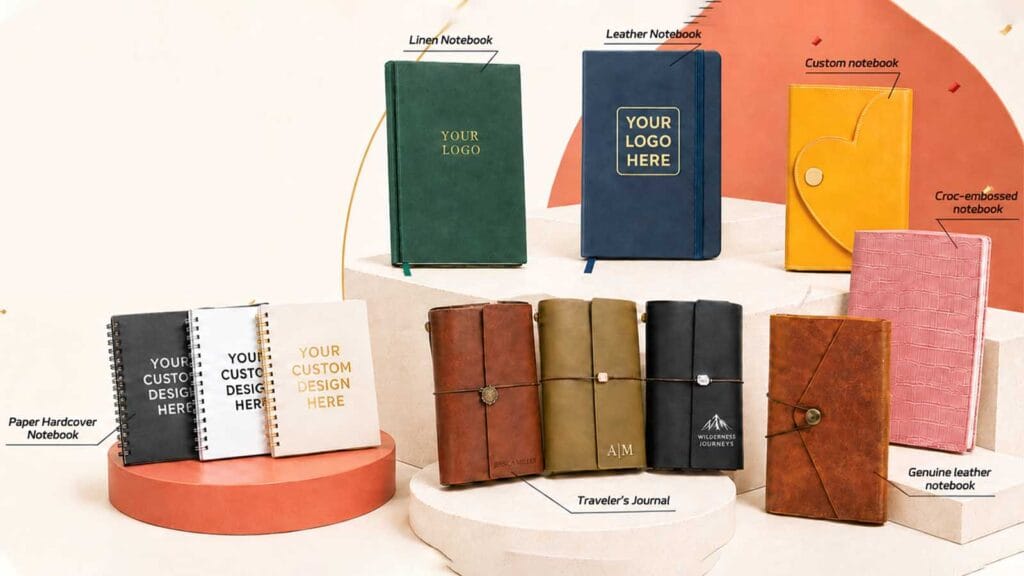
Buying custom notebooks in bulk looks straightforward on the surface: pick a size, choose a cover, add a logo. The moment you actually start requesting quotes, most buyers find that the number of variables shaping the final product — and the final price — is far larger than it first appears.
Take the same A5 notebook and change the paper weight, page count, binding, cover material, logo finish or packaging, and you can end up with a completely different product. So before you email a factory with “how much for 1,000 pieces?”, the more effective move is to define the specification step by step.
This guide walks first-time buyers — brands, gift companies, schools, distributors and corporate procurement teams — through the real sourcing process for custom notebooks in bulk, from specification, MOQ and sampling through to production and shipping.
1. Custom Notebooks in Bulk: Logo Printing or Full Custom?
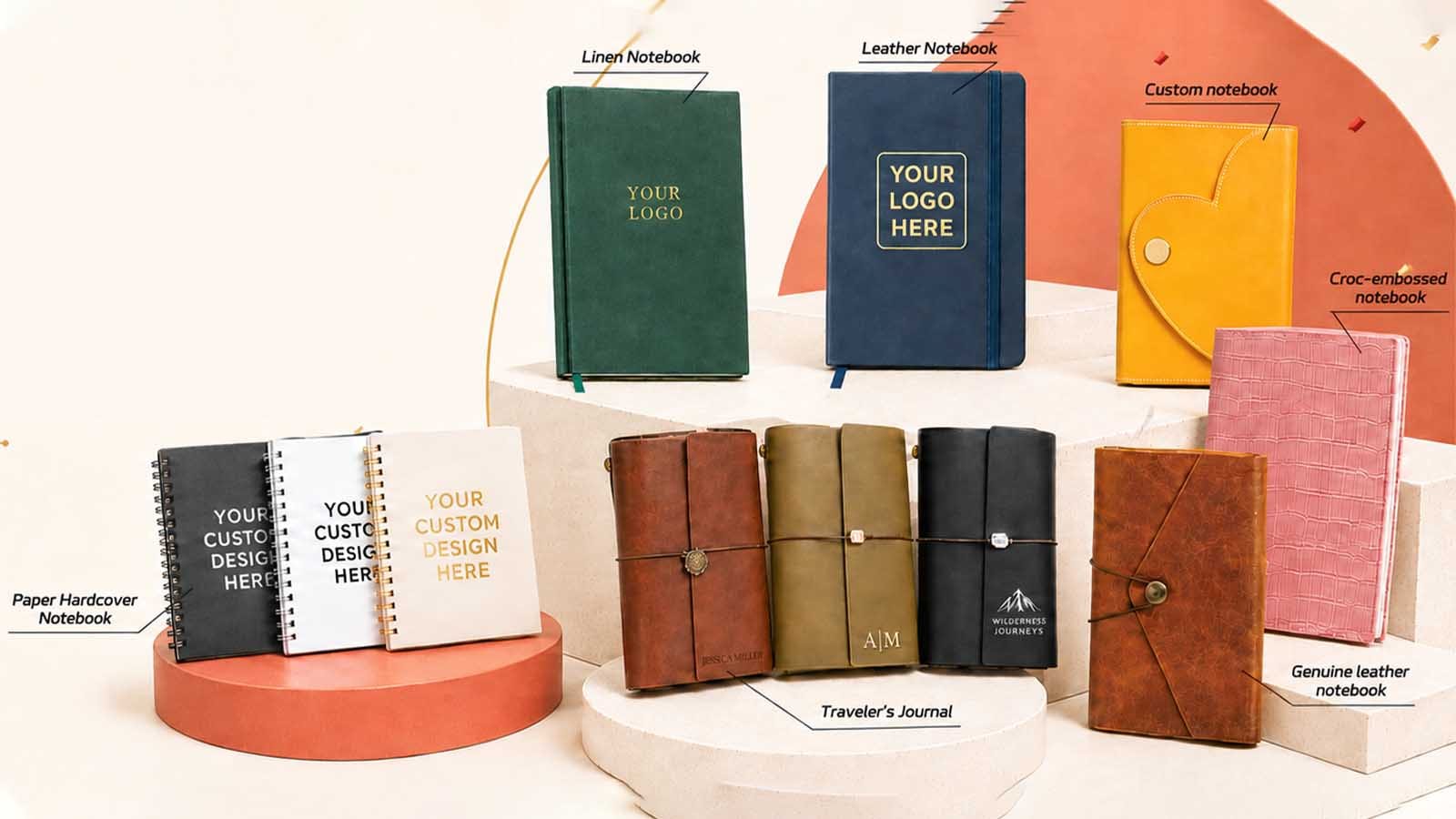
“Custom notebook” can describe very different levels of customisation. The simplest project is choosing an existing notebook and adding a company logo to the cover. A true OEM project can involve re-designing the size, paper, inner-page layout, page count, cover material, binding, logo finish, accessories and packaging from scratch.
Both are called “custom notebooks”, but the production difficulty, MOQ, sample cost and final price for custom notebooks in bulk can be completely different. Before you request a quote, decide which parts you actually want to change.
A corporate gift project may only need a logo added to an existing PU notebook, while a stationery brand preparing to sell at retail may need fully custom covers, brand colours, inner pages, packaging, and even bookmarks and stickers.
If you cannot define every specification yet, that is fine. Telling a manufacturer the intended use, estimated quantity, reference images and target positioning usually gets you a far more meaningful quote than a one-line “please quote custom notebooks”.
2. Define the end use before the specification
For custom notebooks in bulk, many sourcing mistakes are not manufacturing errors — the product structure was simply never matched to its final use. A corporate meeting gift, a school exercise book, a branded retail journal, an event giveaway, a planner and a premium business notebook all have very different requirements for cost, durability and appearance.
- Corporate gifts: cover feel, logo presentation and overall look usually matter most.
- Schools and training: paper, writing experience, durability and cost usually matter more.
- Branded retail product: the unboxing experience matters — cover, inner-page design, accessories and retail packaging.
So before choosing materials, answer one question first: who will use this notebook, and in what situation? That answer drives almost every specification that follows.
3. Choosing a notebook size
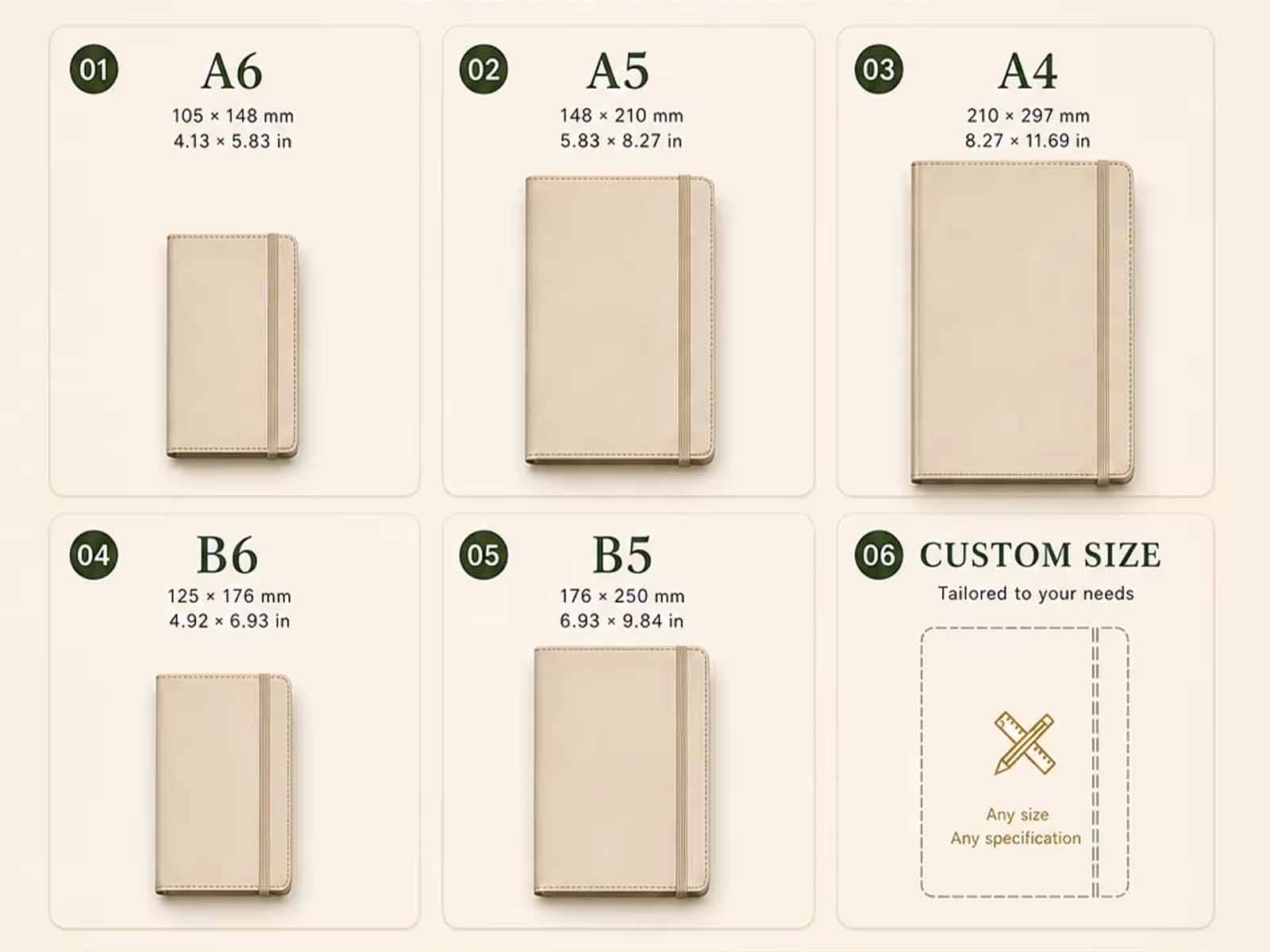
For custom notebooks in bulk, common sizes are A4, A5, A6 and B5, and special sizes can be made to order.
- A4 offers the largest writing area — good for meeting notes, training materials and projects needing a lot of space.
- A5 is the most common commercial notebook and journal size, balancing portability and writing space.
- A6 is smaller and suits pocket notebooks, event giveaways and carry-everywhere use.
- B5 usually offers a larger writing area than A5 and is common in schools, study notes and office settings.
One point buyers often overlook: do not write only “A5” or “B5” — confirm the millimetre dimensions too. This matters most for B5, which can differ across paper-size systems. If your packaging, inner-page files, slipcase or other accessories are already designed around fixed dimensions, writing only “B5” can create unnecessary misunderstandings.
For special projects you can quote directly in millimetres, for example 205 × 143 mm, 290 × 210 mm or 250 × 175 mm. The safest habit is to confirm both: the size name and the actual millimetre dimensions. For reference on how A and B series sizes are defined, see the ISO 216 paper-size standard.
4. Choosing inner paper
When sourcing custom notebooks in bulk, the first question most buyers ask is “is 80gsm enough?” But GSM is only one indicator when choosing paper. Common inner pages use 80gsm, 100gsm, 120gsm or other weights, and heavier paper does not automatically mean every writing tool will be bleed-through free.
Whether ink bleeds through also depends on paper type, surface treatment, opacity, nib width and ink type. So if your customers will use fountain pens, markers or other wet-writing tools, test a physical sample before mass production rather than judging by GSM alone. For a full explanation of how paper weight is measured, see grammage (GSM).
For ordinary office and daily note-taking, choose a weight based on cost, page count and writing feel. For brand products where writing experience matters, it is worth spending time testing different papers.
Another point that is frequently missed: pages and sheets are not the same thing. One sheet of paper usually carries two pages, so always clarify whether you mean pages or sheets when quoting — it prevents the supplier and buyer from talking past each other.
5. How far can inner pages be customised?
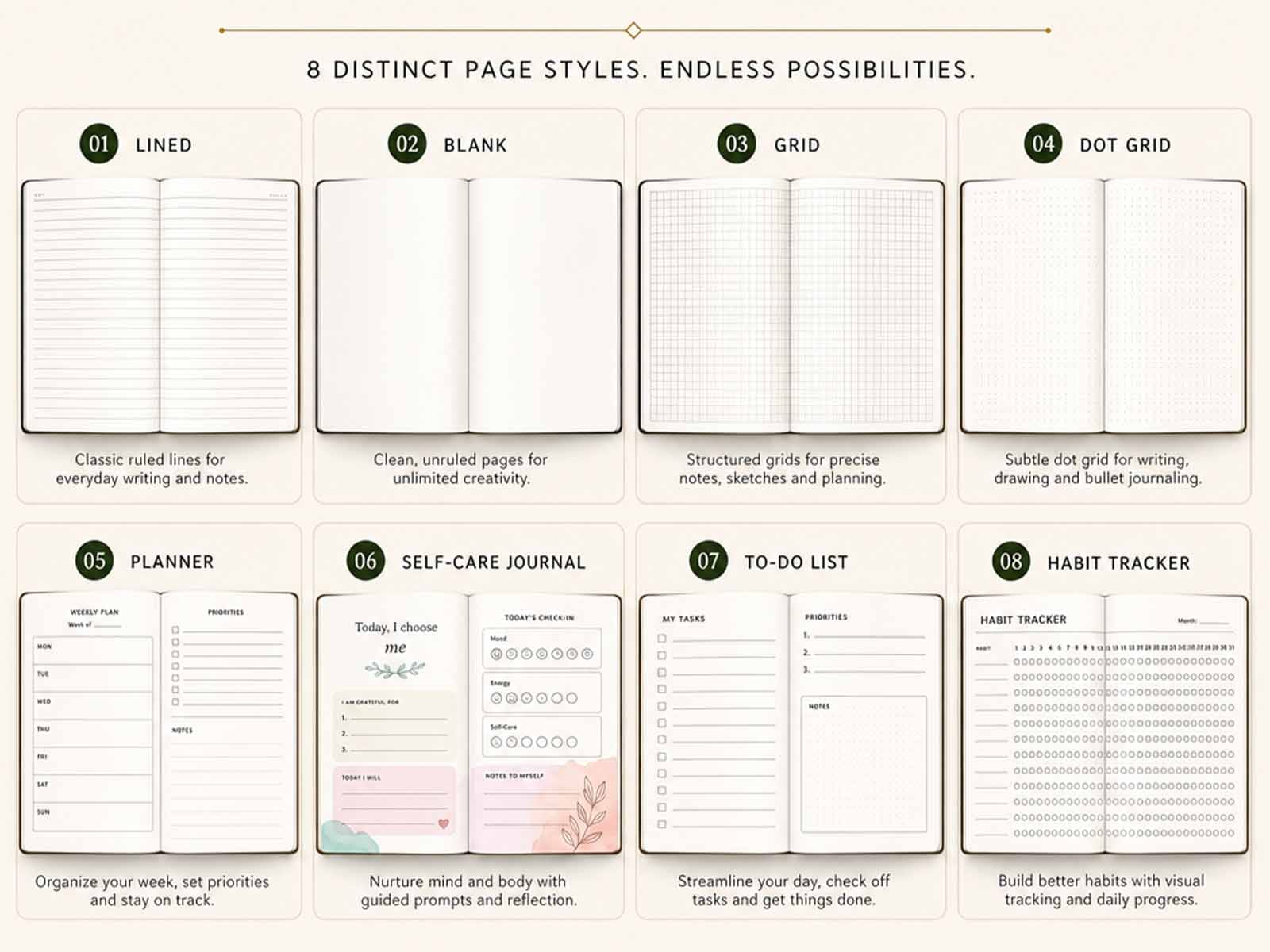
Custom notebooks in bulk do not mean choosing only lined, grid or blank pages. Common inner pages include ruled, grid, dot grid, blank, daily/weekly planners, fitness planners, book review layouts, study logs and other purpose-designed pages.
For fully custom inner pages, production can follow a prepared PDF, with colour or single-colour printing confirmed against the design. For planners, corporate training manuals, branded journals and education products, the inner pages are often the real core of the product — not just the cover.
When you request a quote, say whether every page is identical, whether there are several different layouts, whether it prints in colour, and the total page count. These all change the production method and the price.
6. Choosing a binding method
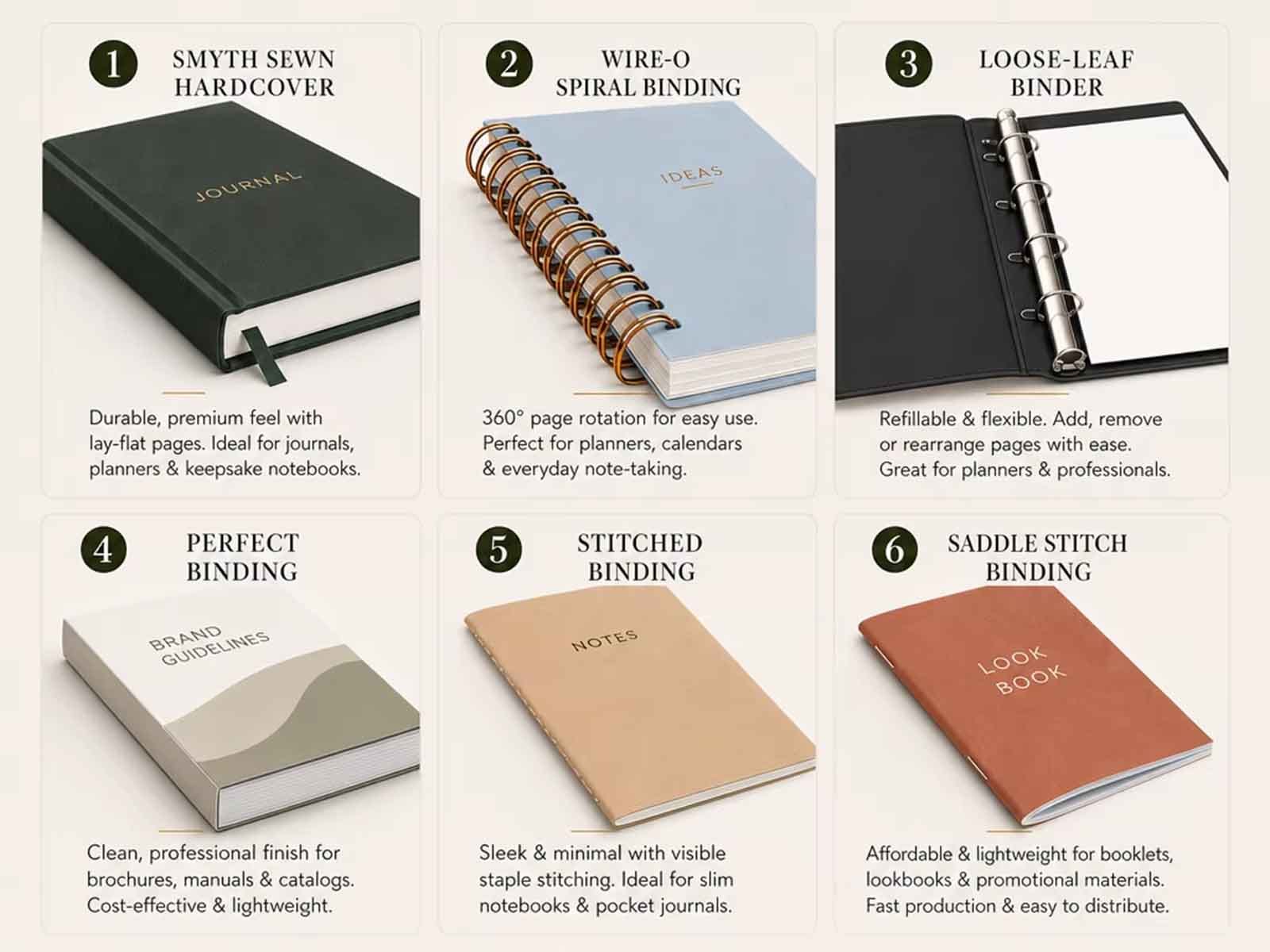
For custom notebooks in bulk, binding affects more than appearance — it determines whether the notebook opens flat, whether it folds 360°, how long it lasts, what it costs and the MOQ.
Spiral / Wire-O
Both are made by punching holes and threading a coil through them. The key feature is that pages turn easily, and some structures open a full 360°, making them ideal for meeting notes, study notes, planners and anything flipped through constantly. Compare spiral and wire-o notebooks for fold-back convenience.
Thread sewn / sewn binding
Sewn binding stitches folded signatures into a book block. If the project prioritises long-term use and a good writing experience once open, consider this structure. A sewn-bound notebook is the usual choice for premium brands that need reliable lay-flat.
Perfect binding
Perfect binding forms a clean square spine, which can also be designed and printed. It is common in books, manuals and some commercial notebooks. See perfect-bound notebooks for thicker, printable-spine projects.
Saddle stitching
Saddle stitching uses metal staples through the folded sheets. It suits thin, high-volume booklets and exercise books but not all thicknesses. Saddle-stitched notebooks deliver the lowest unit cost at high volume.
Loose-leaf / ring binder
If end users need to add, remove or reorder pages, a removable loose-leaf structure works better.
So rather than asking “which binding is best?”, choose by how the notebook will be used: 360° fold-back, durability, a square spine, lowest cost, or replaceable pages. For a deeper comparison of all five, see our guide to notebook binding types.
7. Choosing a cover material
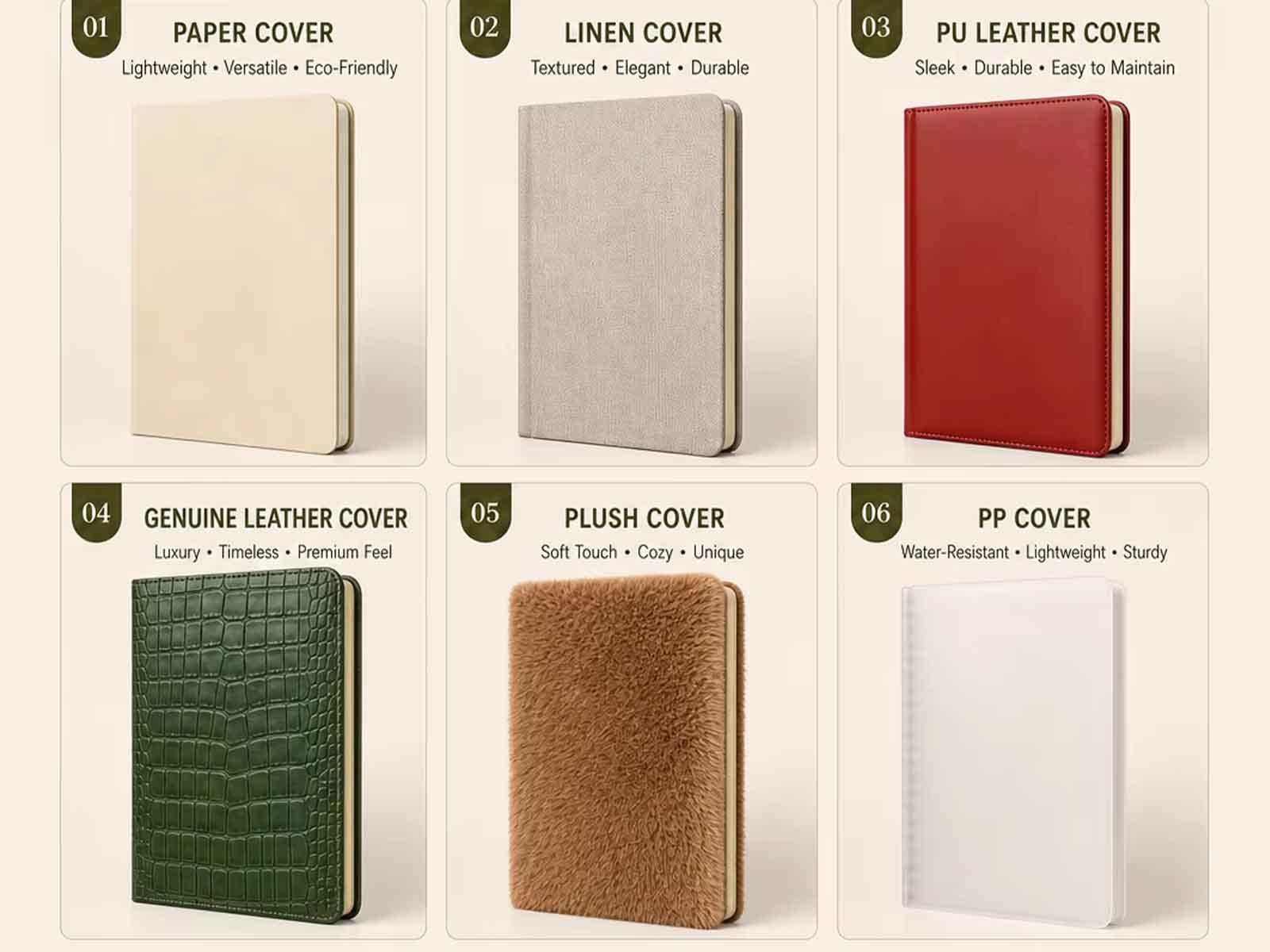
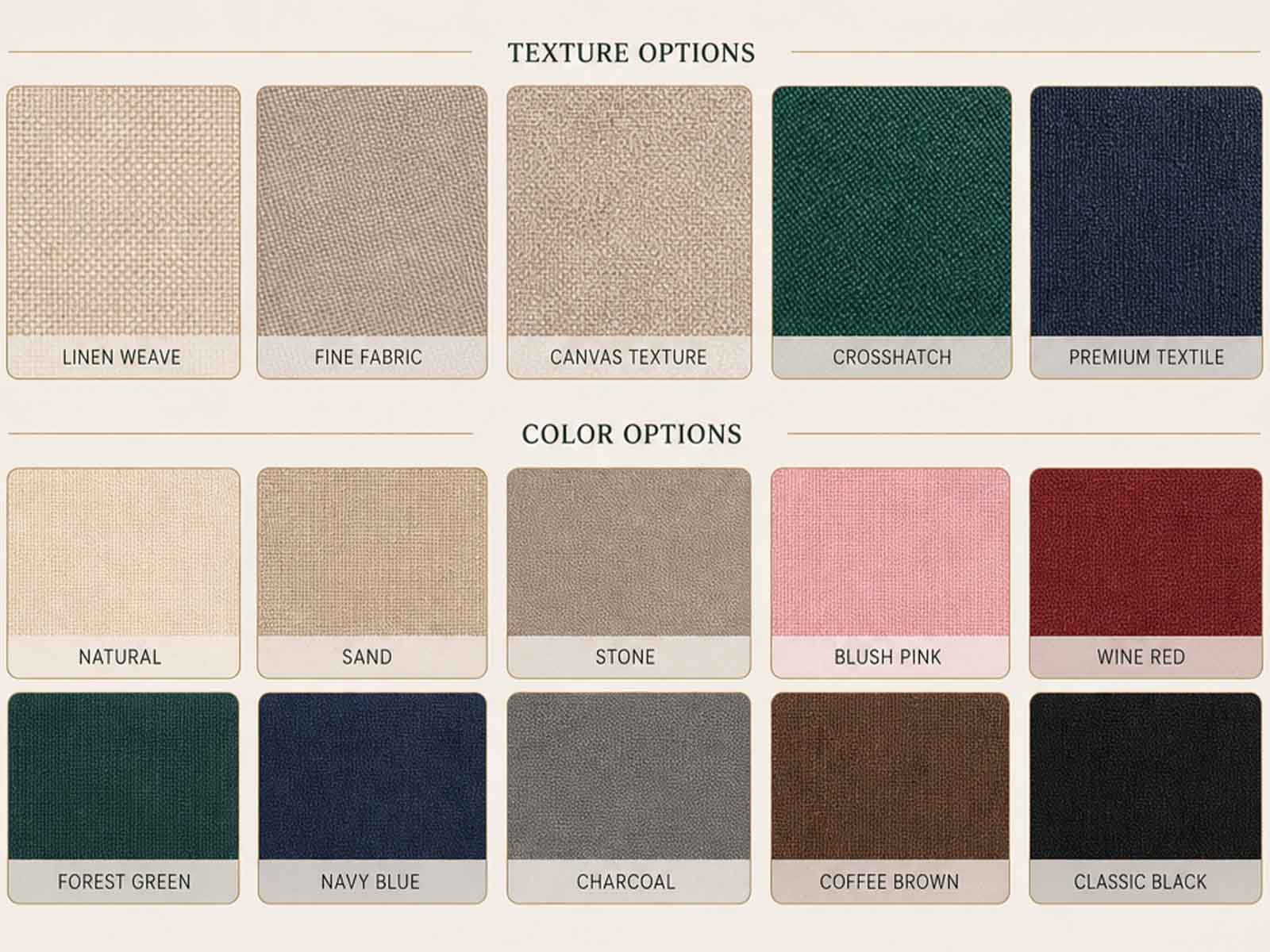
Custom notebooks can use several cover constructions: paper covers, PP covers, PU/leather-style covers, fabric covers and special materials like plush.
- Paper covers offer high print freedom — good for complex artwork, brand visuals and large full-colour designs.
- PP covers are more durable and suit school, office and heavy-use settings.
- PU or leather-style covers suit projects that need a tactile, business look, and can pair with embossing or foil stamping. For a premium retail presence, see hardcover notebooks.
- Fabric covers create a more obvious material texture for brands emphasising design and touch.
- Plush and other special materials are used mostly for children’s, gift and themed designs.
Choose a material against three factors at once: appearance, usage environment and target cost.
8. Logo and cover finishing
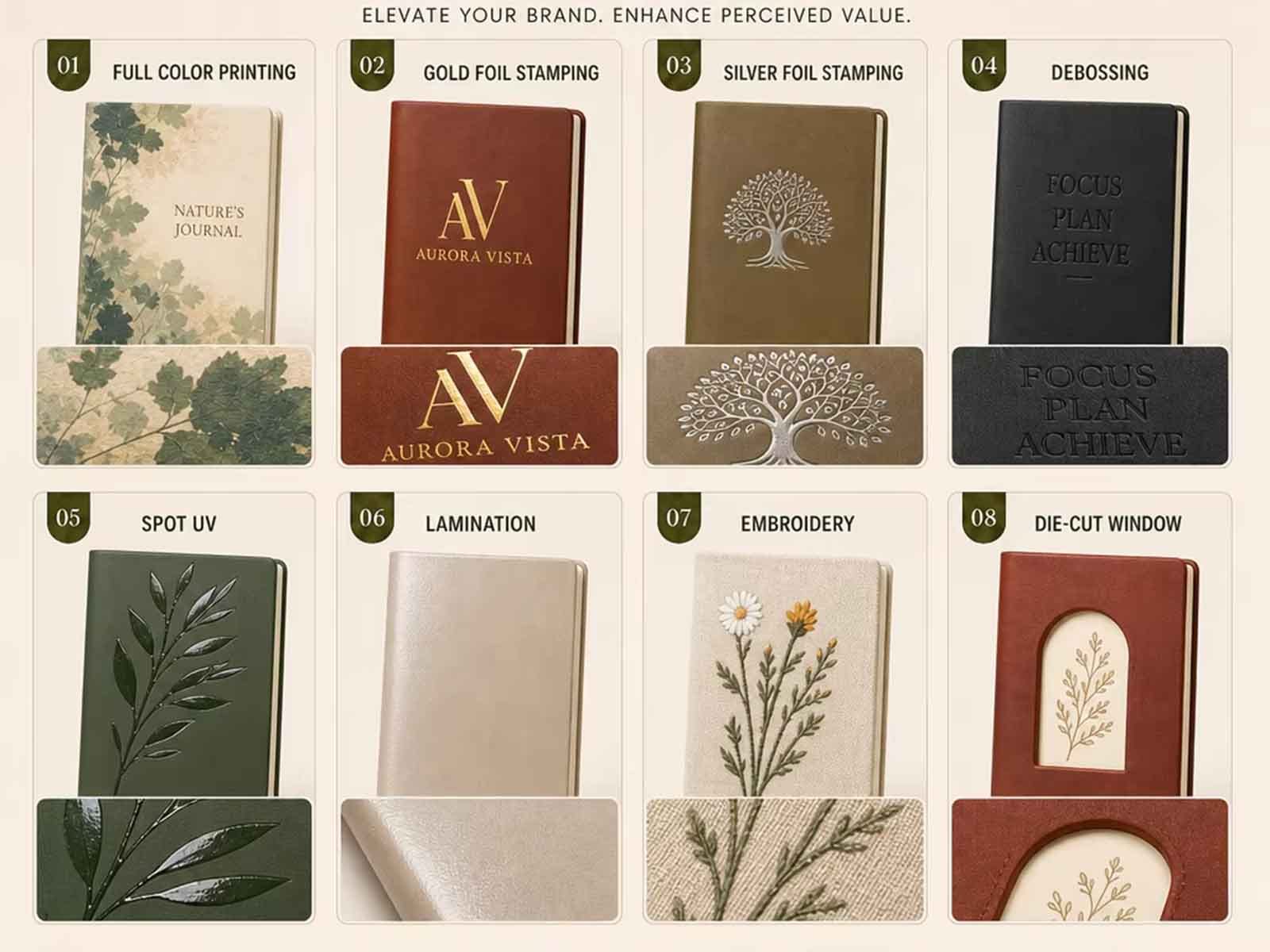
Different logo finishes produce very different results. Gold and silver foil stamping create a metallic effect; embossing raises the design while debossing presses it in. Spot UV creates a glossy area that contrasts with a matte background.
Depending on the cover material and design, you can also choose full-colour printing, spot-colour printing, silk-screen printing, lamination and die-cutting.
Do not tell the manufacturer only “put my logo on the cover”. Instead, send the logo file and a reference effect, and state whether you want it printed, metallic, raised, pressed or another texture. The same logo in different finishes can look — and cost — completely different.
9. Accessories worth adding
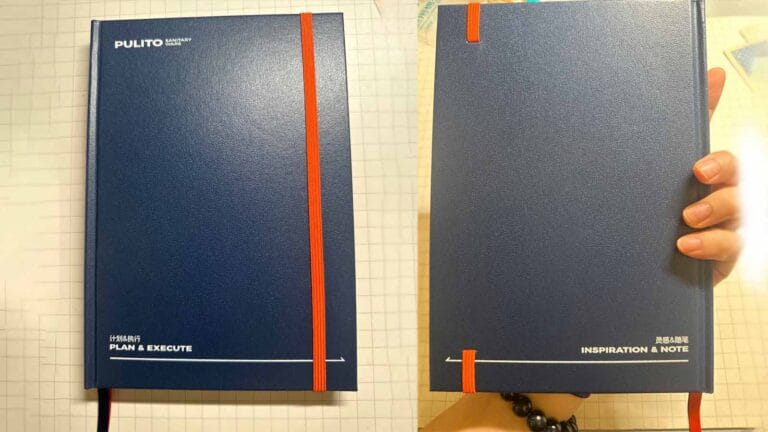
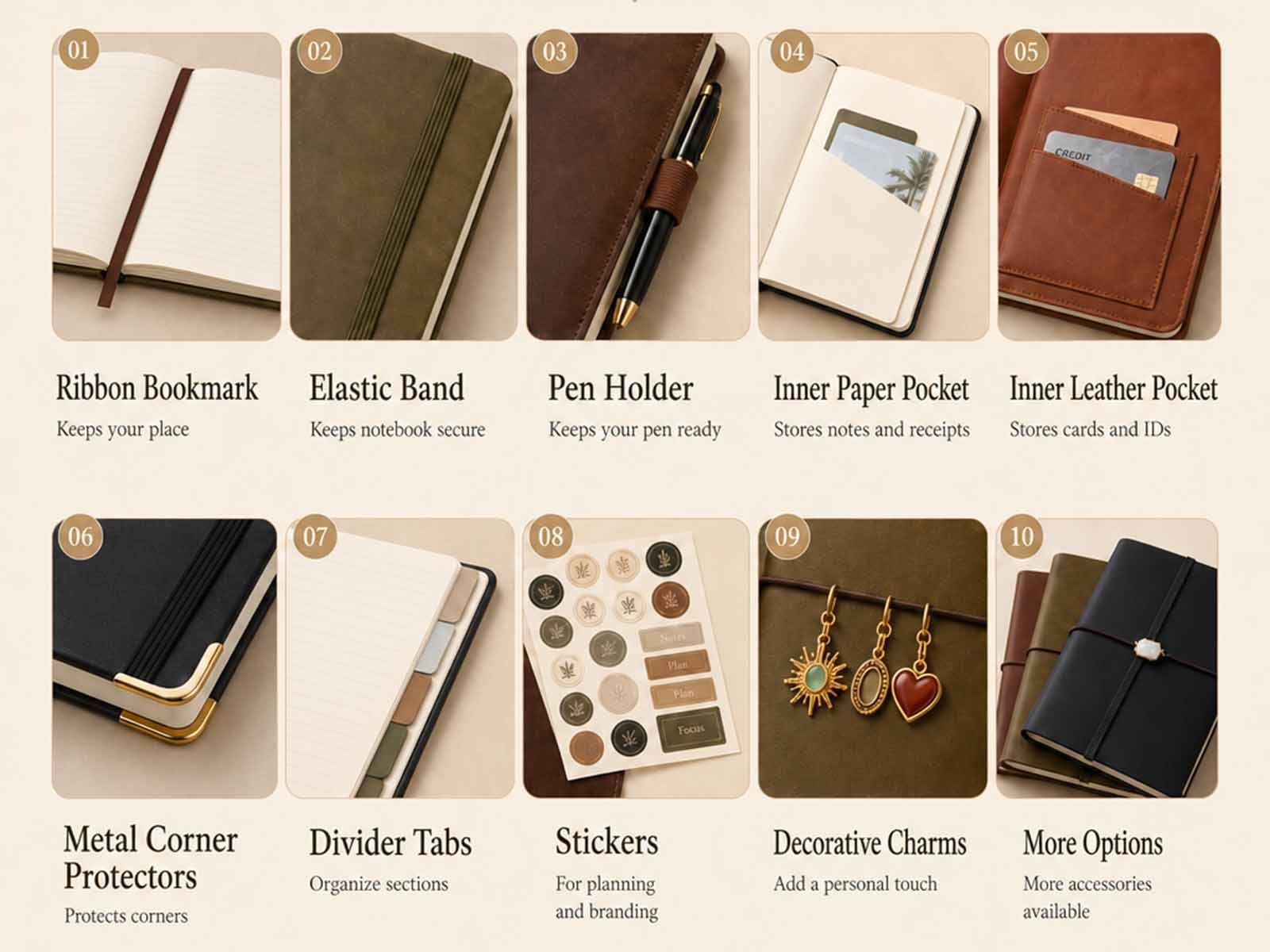
Accessories are not needed on every project, but for planners, corporate gifts and retail brand products they can change the user experience and positioning. Common options include elastic bands, bookmark ribbons, pen holders, inner pockets, tabbed dividers, sticker pages, metal corners and extra notepads.
When choosing, ask not only “can we add it?” but whether it solves a real problem for the end user. A planner benefits from a ribbon bookmark and tabbed dividers; a meeting notebook may benefit more from a pen holder; a corporate gift may suit an elastic band and inner pocket. Adding accessories with no real purpose only raises production cost.
10. Decide packaging at the RFQ stage
For custom notebooks in bulk, packaging is often left to the end of a project, but it affects product cost, shipping volume and final delivery. Common options include OPP bags, shrink film, foldable mailer boxes and top-and-bottom boxes.
- Internal use: simple protective packaging is usually enough.
- Direct-to-retail: complete individual packaging is usually needed.
- E-commerce: packaging must also protect the product in transit.
If you already know the final sales channel, tell the manufacturer in the first inquiry rather than deciding after production.
11. What to send for an accurate quote
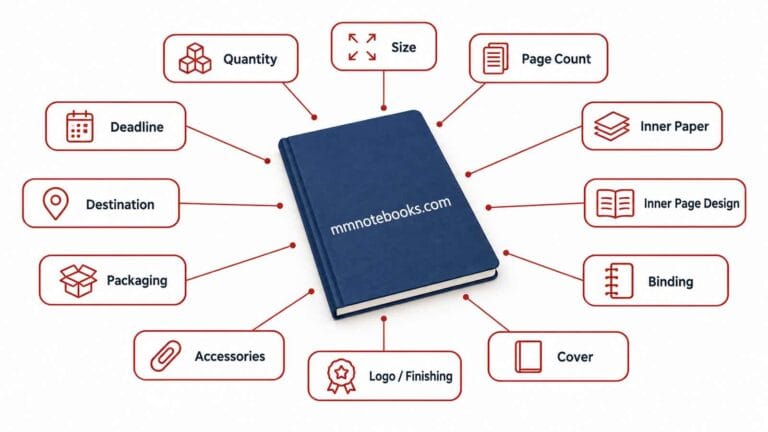
A useful custom notebooks in bulk inquiry does not need a 40-page technical file, but it should clarify the main variables that move cost.
| Information | Example |
|---|---|
| Quantity | 500 / 1,000 / 5,000 pcs |
| Number of designs | 1 design or multiple SKUs |
| Size | A5 / B5 / 145 × 210 mm |
| Page count | 160 pages |
| Inner paper | 80gsm / 100gsm |
| Inner layout | Lined / dotted / custom PDF |
| Printing | Black / full colour |
| Binding | Sewn / spiral / perfect bound |
| Cover | Paper / PP / PU / fabric |
| Logo & finishing | Foil / deboss / print / Spot UV |
| Accessories | Elastic / ribbon / pocket / pen loop |
| Packaging | OPP / shrink wrap / gift box |
| Destination | Country, city or port |
| Required delivery date | The date you need to receive the goods |
If not all of this is decided yet, send the estimated quantity, intended use, reference images, target size and destination first — the manufacturer can help you confirm the rest from there.
12. Custom Notebooks in Bulk: Why MOQ Differs by Notebook Type
Different notebook structures need different materials, production setup and machine configuration, so MOQ should not be treated as one fixed number for every custom notebook. MM Notebooks uses different MOQs by structure:
| Product type | Minimum order quantity |
|---|---|
| Hardcover notebooks, PU leather notebooks, planners & agendas | 500 pcs per design |
| Sewn bound, perfect bound, spiral / wire-o notebooks | 1,000 pcs per design |
| Exercise books | 2,000 pcs per design |
| Saddle stitch notebooks | 10,000 pcs per design |
So if you planned 500 pieces but the structure you had in mind needs a 1,000-piece MOQ, do not abandon the project — ask whether another structure with the same end use has a lower minimum. Order quantity itself is part of the product design. We break down why these numbers work this way in our guide to notebook MOQs by binding.
13. Why samples come before mass production
Pictures and digital proofs confirm the visual direction, but they cannot replace a physical sample. A real sample lets you check the size, paper feel, colour, logo result, binding, opening behaviour and overall experience.
- Stock samples — for checking materials and basic workmanship. MM Notebooks can provide stock samples; the buyer covers shipping.
- Custom samples — made to your logo, design or special specification, and carry a sample fee.
For a project that will run into the hundreds or thousands, finding a problem before production is almost always far cheaper than fixing it after. A safer flow is: confirm specification → confirm artwork → make sample → check sample → approve sample → mass production.
14. What to check on a sample
When the sample arrives, do not only judge whether it “looks good”.
- First check the actual dimensions, page count, paper and cover material against the confirmed specification.
- Then check the logo position, size, colour and finish.
- For fully custom inner pages, check page order, margins, cut position, colours and any wrong pages.
- For writing-experience products, test the paper with the pens end users will actually use.
- For lay-flat products, place the notebook on a desk and test it rather than trusting the binding name.
- For products with elastic bands, ribbons, pockets or pen holders, check their position and how firmly they are attached.
The purpose of sample approval is not to prove the product is “perfect” — it is to establish a production standard both sides accept.
15. Quality control during production
Notebook production involves paper, printing, cutting, binding, cover finishing, logo work, accessories and packaging — so quality control should not begin only when the goods are being packed. MM Notebooks runs a quality-check process from raw-material selection through to final delivery, handled by a dedicated QC team, and every batch is inspected before shipment.
The key point is this: quality control aims to catch and correct problems early, not to claim that industrial production carries zero risk. For B2B buyers, locking the specification and sample down before production is itself part of the quality-control process.
16. Shipping information belongs in the first inquiry
Many buyers ask for the unit price first and only tell the supplier where the goods must go at the end. But the same product shipped to the US, Europe, the Middle East or elsewhere can follow completely different logistics plans.
So provide the destination country, city or port, and the date you need the goods, in your first inquiry. If there is a trade show, promotion, back-to-school date or product launch, say so up front. MM Notebooks returns a component-level quotation within 24 hours and confirms the delivery date in writing before you pay the deposit, and can support the project from design and sampling through to production and logistics.
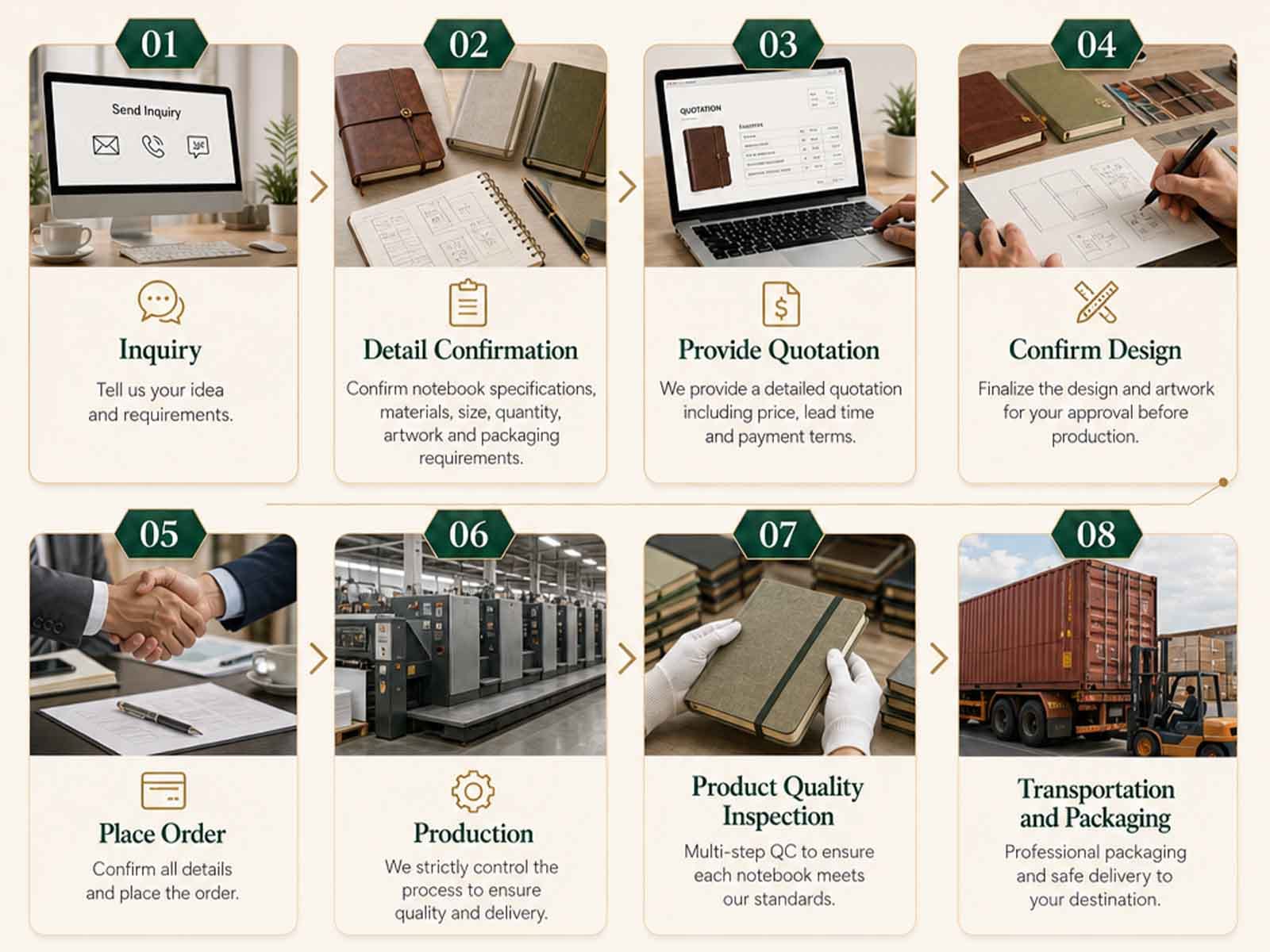
17. The complete ordering process
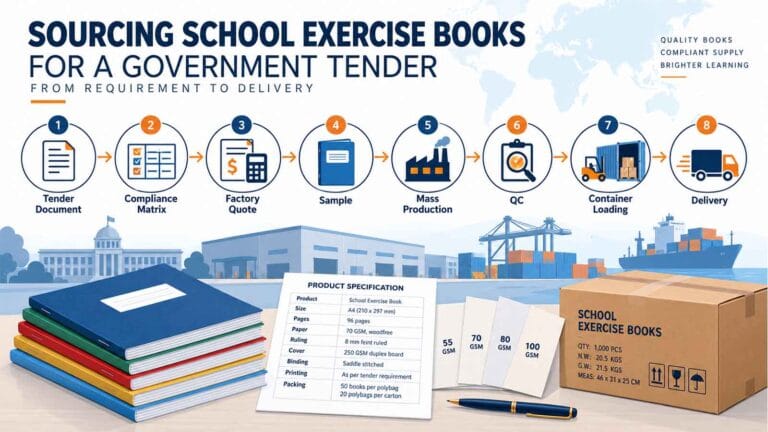
A clear B2B custom project starts with the product requirement, not with payment. The buyer first provides quantity, size, design, packaging and end use. The manufacturer then confirms materials and the production plan and provides a quote. After price and key specifications are agreed, the design files are confirmed. For projects that need sampling, the sample is made and approved before mass production. Production is quality-checked, then packed and shipped per the agreed transport method.
- Requirement confirmation
- Quotation
- Specification confirmation
- Design confirmation
- Sampling
- Sample approval
- Mass production
- Quality inspection
- Packaging
- Shipping
The earlier the key specifications are locked, the easier production is to control.
18. The most common first-order mistakes
- Comparing unit prices without checking whether the specs match. 80gsm vs 100gsm, different cover board, binding and packaging should not be compared directly.
- Relying on the on-screen design and skipping the physical sample.
- Using words that look precise but still leave room to interpret — “A5”, “B5”, “Leather”, “Lay Flat” — without confirming the exact specification.
- Thinking about packaging and logistics only after production ends.
- Piling on accessories and finishes to add selling points without checking whether they actually help the end user.
Good customisation is not “how much can we add” — it is making sure every specification has a clear purpose.
FAQ
Are you a manufacturer or a trading company?
MM Notebooks has manufactured custom notebooks since 2013, supplying brands, schools, distributors and other B2B buyers with bulk customisation services.
Does 80gsm paper guarantee no ink bleed-through?
You cannot judge from GSM alone. 80gsm works for many ordinary writing uses, but actual bleed-through and ghosting also depend on the paper itself, the ink and the writing tool. If the product must handle fountain pens or other special pens, test a physical sample before production.
Can a custom notebook open completely flat?
It depends on the binding. Spiral / wire-o turns very freely and some structures fold a full 360°; certain sewn-binding structures also open flat well. If lay-flat is important, state it at the RFQ stage and confirm it on a sample.
Which size is most common?
A5, A4, A6 and B5 are all common. A5 balances portability and writing space; B5 gives more writing area; A6 is more portable; A4 suits larger-page projects. If the size affects packaging or other accessories, also provide millimetre dimensions.
Can the inner pages be fully customised?
Yes — inner pages can be designed for your project, including ruled, dot, grid, planner, fitness, book review and other layouts. If you have a PDF ready, we can confirm a colour or single-colour printing plan from it.
What is your MOQ?
MOQ depends on the product structure. Hardcover, PU leather and planners start at 500 pcs per design; sewn bound, perfect bound and spiral / wire-o start at 1,000 pcs; exercise books start at 2,000 pcs; saddle stitch starts at 10,000 pcs.
Can I get a sample before a bulk order?
Yes. To review existing products and materials you can request a stock sample (the buyer covers shipping). To make a sample to your own design, the corresponding custom sample fee applies.
Before you send your inquiry
Ordering custom notebooks in bulk does not require you to become a printing or binding expert. What matters is letting the manufacturer understand what you are making, who it is for, roughly how many you need, and which requirements cannot change.
If you already have a complete specification, send the size, page count, paper, binding, cover, logo, packaging and quantity for a quote. If you only have a concept, send reference images, estimated quantity, intended use and target market first, and define the specification step by step.
A good quote is built on a clear product definition — and a reliable bulk order usually starts there too.